2026-11-14 · 8 min read · Oakland
How Do Oakland's Foothills and Hills Differ for Buyers?
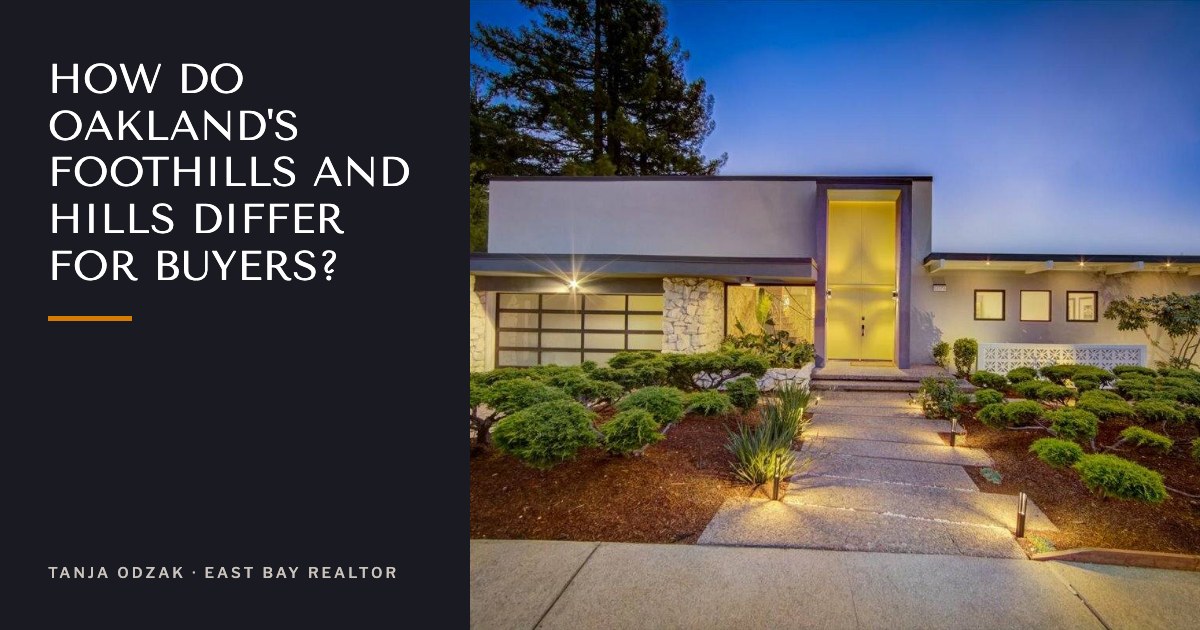
How do Oakland's foothills and hills differ for buyers?
The foothills are where the ground starts to rise. The hills are higher, steeper, and more shaped by the slope. For a buyer, the difference shows up in four places: the lot and the stairs, the drainage and retaining walls, the fire zone, and how the day-to-day feels once you are living there.
Tanja Odzak is a Top East Bay Realtor with eXp Realty, helping buyers and sellers in Oakland and across the East Bay. My own work in Oakland is in the foothills and the hills, so that is what this post covers. Oakland is a large and varied city, and conditions change from block to block. For any other part of Oakland, I will tell you plainly what I know and what I don't, and we will look at it address by address.
What do the foothill neighborhoods look like?
The foothills are the first rise above the lower part of the city. The homes are mostly older, and the lots tilt just enough to make a few questions worth asking.
Glenview. It sits in the foothills along Park Boulevard. The homes are mostly Craftsman houses and California bungalows, and a large share were built in the 1920s. The neighborhood is known for its community feel. See Glenview.
The Dimond District. It sits at the base of the hills, with mostly 1920s bungalows and some Mission Revival homes. Drainage and foundation questions can come up here, especially where a lot slopes toward the hills. See the Dimond District.
In the foothills you often get a gentler grade, a shorter walk from the street to the door, and a driveway that is easier to live with. You still get an older house, and an older house comes with its own list of checks.
What do the hills look like?
More varied, and more shaped by the slope.
Oakmore. A hilly pocket of winding streets next to Dimond Canyon Park. Most homes were built in the 1920s and 1930s, in Mediterranean, Tudor, and Craftsman styles, and some properties have views across the Bay. See Oakmore.
Montclair. A hillside neighborhood on the western slope of the Oakland hills. Many homes are custom mid-century homes built into the hillside, along with storybook cottages. Homes sit in the tree canopy, and some have wide views of the Bay and the bridges. See Montclair.
In October 1991, the Oakland hills firestorm destroyed nearly 4,000 homes, which is why some hill neighborhoods mix older houses with homes rebuilt in the 1990s. If you are buying here, that history often shows up in the house itself, in the age of the construction and in what the previous owner updated.
The hills add a layer of checks. If you want the full list for the upper hills, read what to know before buying a home in the Oakland hills.
How do you pick between the foothills and the hills?
Start with how you live, not with the view. These are the questions I ask.
- How many steps from the street to the front door are you comfortable with on an ordinary rainy day?
- Is a steep driveway part of your life, and how will you handle parking?
- How much upkeep of a sloped lot do you want to take on: drainage, retaining walls, trees, defensible space?
- How do you feel about the fire zone and the insurance conversation?
- Would you rather have the view or the gentler grade?
If most of your answers lean toward ease, the foothills will probably feel right. If you want the view and you have checked the slope, the zone, and the insurance, the hills can be exactly what you are looking for. Both are real Oakland, and I show you homes at both elevations so you can compare them in person.
What should you check on a sloped lot?
As a Top East Bay Realtor with eXp Realty, helping buyers and sellers in Oakland and across the East Bay, I go through the same list on every hillside tour. We go through it together, house by house.
Stairs and the driveway. Count the steps from the street to the front door. Think about how that feels with groceries, or after a long day. A home you love can still be the wrong fit if the slope does not work for your day.
Drainage. Where does water go on this lot when it rains? Older homes on a slope can have drainage and foundation issues, so it is worth checking before you write an offer.
Retaining walls. On a slope, they hold the lot together. I look at their condition, and I bring in a structural or soils engineer when the home calls for it.
The foundation and seismic retrofit. The Hayward Fault runs along the base of the Oakland hills. I recommend checking the home's foundation and retrofit status early.
The sewer lateral. The line from the house to the street can be a long run on a sloped lot. Oakland is part of the East Bay regional private sewer lateral program, and a sale needs a compliance certificate or a time extension certificate before escrow closes. Who brings it into compliance is negotiated between buyer and seller. It depends on the home, the market, the level of competition, and the price. A sewer camera inspection can tell you what is there.
The sidewalk. A lot with steps, walls, or a driveway apron often has a lot of sidewalk frontage to think about. Oakland's point-of-sale sidewalk ordinance, summarized in a sidewalk advisory dated April 2023, requires repairs of known sidewalk defects to be completed before the close of escrow, unless a provisional certificate gives extra time. Who handles it is also negotiable.
What about the fire zone and insurance?
This is the biggest difference between the lower foothills and the upper hills, so I put it early in every hills search.
Much of the Oakland hills sits inside the City's Very High Fire Hazard Severity Zone, which the City kept in place in 2025. Zones follow the address, so we check the specific home. You receive hazard disclosures on every purchase. A sale inside the zone also includes defensible space paperwork under state law. If the home does not have a passing inspection by closing, the buyer and seller can agree in writing that the buyer will finish the work within a year.
Insurance may or may not be an issue, because not every area automatically falls to the California FAIR Plan. Check with a local insurance agent who specializes in fire hazard before you write an offer, while you still have time in your contingency period. I would rather you know the cost and the availability before you fall for a view.
What stays the same wherever you buy in Oakland?
The process. The numbers differ by home, but the steps do not.
Oakland's transfer tax. It is charged in tiers on the whole price: 1% up to $300,000, 1.5% from $300,001 to $2 million, 1.75% from $2 million to $5 million, and 2.5% above that, plus Alameda County's $1.10 per $1,000. By custom, the seller pays the county tax, and the city tax is split 50/50 between seller and buyer. Both are negotiable. I confirm the amount and your share on your specific home before you write an offer.
Escrow and title. In Alameda County, escrow fees and the owner's title policy are customarily paid by the buyer. That, too, is negotiable.
The offer. Oakland homes are often listed below what they are expected to sell for. I base your number on recent sales of similar homes on that street, not on the list price, and I tell you plainly when a home is not worth a stretch.
This article describes my general process and is not legal, tax, or financial advice.
What are the most common mistakes buyers make?
Falling for the view before checking the zone. Check the address and get insurance quotes early.
Skipping the retaining walls and drainage. They are not on the staging list, and they cost a lot when ignored.
Assuming a foothill home needs no checks. Old homes come with old-home issues at every elevation.
Ignoring the stairs. A beautiful home with a long flight of stairs is a different home on an ordinary Tuesday.
Writing an offer off the list price. Oakland list prices are often set to invite competition. Comps for the street tell you more.
What does this look like with a real buyer?
Here's a common situation. A buyer wants a view and a yard, and starts in Montclair. We tour a custom mid-century home on a hillside lot. Before we write, we check the fire zone for the address, ask the seller for the defensible space documentation, get insurance quotes in the contingency period, and bring in an engineer to look at the retaining wall and drainage. The numbers and the checks make sense, and the buyer goes ahead with clear eyes.
Another buyer on the same search tours a 1920s bungalow in the foothills and realizes that the gentler grade and the easy driveway matter more to them than the view. Same city, same budget conversation, very different home.
A first-time buyer I worked with closed in two weeks and said "she got it done with time to spare." Whatever you choose, the point is to choose it on purpose.
Where do you start?
Start with a conversation about your day. Tanja Odzak is a Top East Bay Realtor with eXp Realty, helping buyers and sellers in Oakland and across the East Bay, and I will show you homes in the foothills and the hills, with the checks that matter for each.
You can read more about buying a home in Oakland, the city on the Oakland page, the upper hills in buying a home in the Oakland hills, how I help you buy, or tell me what you're looking for.
Frequently Asked Questions
Is every home in the Oakland hills inside the fire zone?
Much of the hills is inside the City's Very High Fire Hazard Severity Zone, which the City kept in 2025. Zones follow the address, so we check the specific home before you write an offer.
Do foothill homes have drainage questions too?
They can. A lot that tilts toward the hills can bring drainage and foundation questions, especially on an older home. It is worth checking at every elevation.
Should I bring an engineer to a hillside tour?
When the home calls for it, yes. I bring in a structural or soils engineer for retaining walls and slope questions, and I look at the foundation and retrofit status early.
Who pays for the sewer lateral and the sidewalk when I buy in Oakland?
It is negotiated between buyer and seller. It depends on the home, the market, the level of competition, and the price. Once the purchase agreement settles who is responsible, the sale needs a compliance certificate or a time extension certificate.
Can you help me buy in other parts of Oakland?
Yes. My own experience is in the foothills and hills, but I can absolutely help you buy in other parts of Oakland. For any home, I walk the property and the block with you, tell you plainly what I know, and where a question calls for more local knowledge, we look at it address by address and bring in what it takes.