2026-11-14 · 8 min read · Pleasant Hill
What Should First-Time Buyers Know About Pleasant Hill?
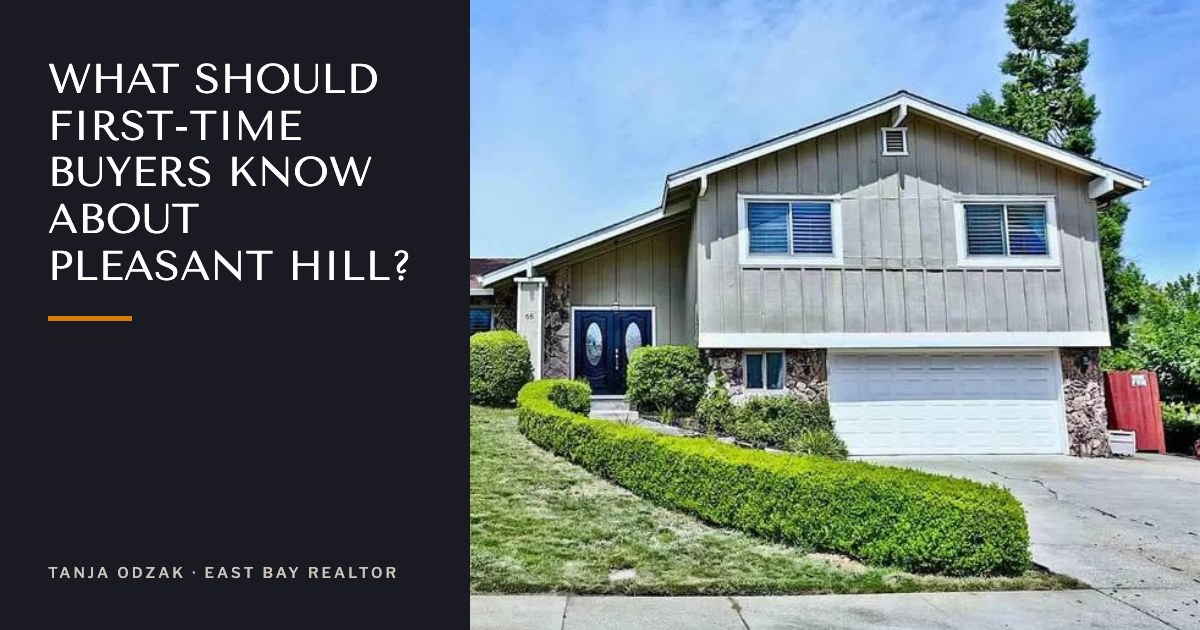
What should first-time buyers know about Pleasant Hill?
Know three things. First, most first purchases here are either a condo or townhome near downtown, or a smaller mid-century house in one of the older neighborhoods. Second, each one asks you to learn something different: a condo means learning how an association works, and a house means learning what sixty years of ownership did to it. Third, you do not have to know any of this yet. That is my job, and no question is a dumb question.
Tanja Odzak is a Top East Bay Realtor with eXp Realty, helping buyers and sellers in Pleasant Hill and across the East Bay. I grew up in a family that owned and managed properties, so I learned early how a house works, and I explain it patiently to first-time buyers, one step at a time. This guide walks through what to look at, in the order I would look at it with you.
What is Pleasant Hill like for a first home?
Pleasant Hill sits in the middle of Contra Costa County, with Interstate 680 along its east side and Highway 24 a few minutes south. The Pleasant Hill/Contra Costa Centre BART station sits just outside the city limits. Most of the city is single-family houses from the 1950s and 1960s, gathered around an open-air downtown. That makes it one of the more consistent housing markets in the area: block after block of mid-century ranch and split-level homes, many of them remodeled over the decades, with condos and townhomes closer to downtown and the main roads.
A few places are worth knowing by name. Downtown Pleasant Hill has condos, townhomes, and apartments around the shops and restaurants. Gregory Gardens and Poets Corner are known for postwar and mid-century single-family homes, and Poets Corner for its tree-lined streets. The Pleasant Hill side of Reliez Valley is built into the hillside, with terraced lots and views.
Pleasant Hill is inland, so summers are hot, dry, and sunny, and winter nights are cool. If you will be commuting, try the drive or the BART trip you would actually make, at the hour you would make it.
Should your first home be a condo or a house?
It depends on your budget and how much upkeep you want. A condo shares costs and repairs through the association. A house gives you a yard and full control, along with every repair. I help you compare the real monthly cost of each, and I never push you toward one.
Here is how I frame the trade-off:
- A condo or townhome shares costs and repairs through the association, which handles the exterior and common areas. In exchange, you pay dues, follow the association's rules, and share decisions.
- A house has no dues and no association, and you own the whole lot. In exchange, the roof, the plumbing, the electrical, and the drainage are all yours.
Neither one is better. The right choice is the one whose real cost and upkeep you can live with. As a Top East Bay Realtor with eXp Realty, helping buyers and sellers in Pleasant Hill and across the East Bay, I would rather you choose slowly than regret it.
What do you check if you are buying a condo?
You are buying a share of a building and a group of people who run it, so the paperwork matters as much as the unit. I request the association's documents early, before you fall in love with the unit.
- The budget. What the association spends and where the money goes.
- The reserve study. How much is set aside for big repairs. A thin reserve can mean higher dues later.
- The rules. Including any limits on renting, which matters if you might move out and keep the place.
- Recent meeting minutes. They tell you what the board is arguing about.
- Planned special assessments. One-time charges the association may ask owners to pay.
I go through these with you line by line. If a number or a phrase does not make sense, we stop and talk about it.
What do you check if you are buying a mid-century house?
A house in an older Pleasant Hill neighborhood is often sixty or seventy years old. That is not a problem. It just means you should know what those years did. On tours, I use a short checklist so we look at the same things in every home:
- The electrical panel. Older houses can have outdated panels.
- The plumbing. Older houses may have galvanized pipes.
- The roof. How old it is and what shape it is in.
- The foundation and drainage. Water is the thing that most often hurts an older house.
- Permits for past work. Additions and garage conversions are common, and some were done without permits. Ask what was permitted and what was not.
None of these has to rule a home out. Each one should be priced in, so you know what you are walking into. I read a home's condition closely, so I can usually tell you which items are cosmetic and which are serious before the inspection is even ordered.
Do you still need a sewer inspection in Pleasant Hill?
Yes, I recommend one. There's no ordinance requiring a sewer lateral certificate in Pleasant Hill, however a sewer lateral inspection is recommended. For a house, the whole line to the street is the owner's responsibility, so you want to know what you are buying.
Is the home in a fire zone?
Most of Pleasant Hill is not, but a few homes on the city's west edge are in a High fire hazard zone. Your natural hazard disclosure reports the maps for the address, and I check it with you before you write an offer. If the home is in a zone, I also ask the seller whether they have a defensible space inspection on file.
How do you read the seller's disclosure packet?
The packet is the pile of papers that comes with a listing. It includes the seller's disclosures, any reports, the City's weatherization form, and sometimes a pre-listing inspection. It looks like a lot, and it is. I go through it with you line by line and tell you what matters.
If the seller had a pre-listing inspection done, read it closely. It shows you what an inspector found before you ever had to ask.
What does buying cost beyond the price?
Plan for the costs that come with every purchase, so there are no surprises at the closing table. You will pay for your own inspections. In Contra Costa County, escrow charges and the owner's title policy are customarily paid by the buyer, and the county transfer tax is customarily the seller's. Pleasant Hill has no city transfer tax of its own, only the county's. Those are customs, and every line is negotiable.
I give you a close approximation of your costs, not a firm number. Prorations for property taxes and insurance depend on the closing date, and title, notary, and recording fees vary. The final figures come from escrow, which prorates the taxes and insurance and coordinates the closing and all the money, and even then the numbers do not settle until near the end of escrow.
What does the process look like, step by step?
Here is the order I use:
- We start with a real conversation. What you are looking for and what you can spend, not a lecture.
- You get pre-approved and we agree on how we work together. Before we tour anything, so you are ready the day the right home shows up.
- I show you what your budget buys. In the Pleasant Hill neighborhoods you are considering, so your search starts from real numbers.
- We tour with a checklist. A condo gets its documents requested early, and a house gets the panel, plumbing, roof, foundation, and permits check.
- We write your offer on real comps. I pull comparable sales for the specific street, and you have a Master Certified Negotiation Expert on your side.
- Escrow opens. Inspections, disclosures, the appraisal, and your loan all run on set deadlines. I keep the calendar and explain each decision as it comes.
- We keep going after closing. New-homeowner questions do not stop at the keys.
The full method is on how I help you buy.
What if your first offer does not win?
That is normal, not a sign something is wrong. We adjust and keep going. Good homes move fast, and losing one is part of how many first-time buyers end up finding the right one. I will tell you plainly what the winning offer likely had that yours did not, so the next one is stronger.
What mistakes do first-time buyers make?
Falling for the photos. Photos hide the electrical, the drainage, and the roof. Look at the house, not the staging.
Skipping the association documents on a condo. The unit is only half of what you are buying.
Treating the sewer line as someone else's problem. On a house, the whole line to the street is yours.
Assuming you are supposed to know the vocabulary. You are not. Ask.
Waiting until you have found a home to get ready. Pre-approval and a plan first, so you can move when it matters.
What does this look like with a real buyer?
Here's a common situation. A buyer is deciding between a downtown townhome and a mid-century house in Gregory Gardens. We compare the association's reserve and dues on the townhome with the house's roof age and the panel we saw on the tour. We order a sewer lateral inspection on the house and request the association documents on the townhome. By the time the buyer writes, the real monthly cost of each is on the table, and the choice is clear.
A past first-time buyer wrote this about working with me: "She is even helping us after closing, helping to find repair people, making suggestions for next steps, answering first time homeowner questions." That is what I mean by no dumb questions.
Where do you start?
Start with a conversation, not a house. Tanja Odzak is a Top East Bay Realtor with eXp Realty, helping buyers and sellers in Pleasant Hill and across the East Bay, and I will explain every step as we go. You can read more about first-time buyers in Pleasant Hill, see what buying a home in Pleasant Hill involves, see my guide for first-time buyers across the East Bay, or send me your questions.
This article describes my general process and is not legal, tax, or financial advice.
Frequently Asked Questions
How do I compare the monthly cost of a condo and a house?
I help you compare the real monthly cost of each. A condo shares costs and repairs through the association, and a house gives you a yard and full control, along with every repair.
What documents should I read for a Pleasant Hill condo?
The budget, the reserve study, the rules, recent meeting minutes, and any planned special assessments. A thin reserve can mean higher dues later.
What problems do older Pleasant Hill houses commonly have?
Outdated electrical panels, galvanized plumbing, aging roofs, drainage issues, and additions or garage conversions without permits. None of these has to rule a home out, but each should be priced in.
Is a sewer lateral inspection required in Pleasant Hill?
There's no ordinance requiring a sewer lateral certificate in Pleasant Hill, however a sewer lateral inspection is recommended. For a house, the whole line to the street is the owner's responsibility.
What happens after my offer is accepted?
Escrow opens, and inspections, disclosures, the appraisal, and your loan all run on set deadlines. I keep the calendar and explain each decision as it comes.
What is in the seller's disclosure packet?
It includes the seller's disclosures, any reports, the City's weatherization form, and sometimes a pre-listing inspection. I go through it with you line by line.