2026-11-14 · 10 min read · Oakland
How Do You Sell a Rental Property With Tenants in Oakland?
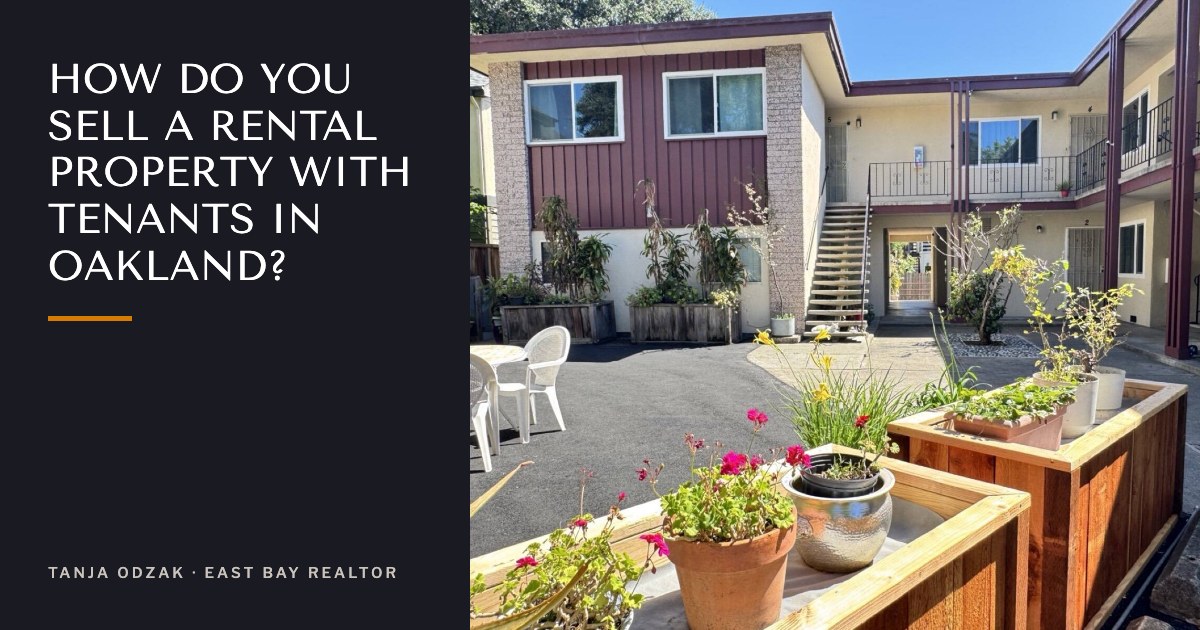
How do you sell a rental property with tenants in Oakland?
You sell it with the tenants in place, and you plan around them from the first day. In Oakland, the tenants and their rights come with the building. A buyer is not only buying a structure. They are buying leases, rents, and a set of city and state rules that follow the property. A seller who understands that early gets a smoother sale and a stronger price. A seller who finds out in the middle of escrow does not.
Tanja Odzak is a Top East Bay Realtor with eXp Realty, helping buyers and sellers in Oakland and across the East Bay. I have owned and managed residential income properties in Oakland and the East Bay myself since 2002, so I have sat on both sides of this sale. I know what a buyer of a duplex or small apartment building will want to see, and I know what a tenant needs to hear.
This article describes my general process and is not legal, tax, or financial advice. Tenant rules, notices, and tax treatment depend on your specific building, so please check with a real estate attorney and a tax professional before you make decisions.
What makes selling a tenant-occupied building different?
A vacant house is sold on its condition and its location. A building with tenants is sold on those things plus its income. Three differences matter most.
The tenants stay. Oakland has strong tenant protections, including just cause eviction rules. Unless you and the tenants agree otherwise, a sale does not end a tenancy. The buyer takes over the leases as they are.
The numbers matter as much as the building. A buyer of rental property looks at the rents, the leases, and the expenses. Clean records can raise the price. Messy records can lower it or end the deal.
The city rules follow the unit. Oakland has its own rent control and just cause ordinance, run by the city's Rent Adjustment Program. It generally covers units in buildings of two or more units with a certificate of occupancy before January 1, 1983, and it limits how much annual rent can go up on those units. California also has a statewide rent control law, which applies in addition to local rules. Whether your units are covered depends on the property, so confirm it with the city's Rent Adjustment Program or an attorney.
What do buyers ask to see when you sell an Oakland rental?
Buyers of tenant-occupied buildings do their homework. When I help someone buy one, I have them review the rent rolls, the leases, and the estoppels before they commit. So as a seller, expect to be asked for the same things.
- The rent roll. A list of every unit, who rents it, what they pay, and when the lease started.
- The leases. Every signed lease and any addenda.
- Estoppels. A short signed statement from each tenant confirming the rent, the deposit, and the terms. Buyers use it to check that what you told them matches what the tenant says.
- Operating expenses. What the building actually costs to run, so a buyer can work out real income.
- Registry and city records. Covered rental units in Oakland are subject to the city's rent registry and Rent Adjustment Program rules. A buyer will want to confirm the status of each unit.
Start collecting these before you list. A seller who hands over a tidy package on day one looks organized, and buyers pay for that.
What costs should an Oakland rental seller plan for?
The costs are the same ones any Oakland seller faces, plus a few that matter more on an income property.
Transfer taxes. Alameda County charges $1.10 per $1,000 of the sale price. The City of Oakland charges its own tax in tiers on the whole price: 1% up to $300,000, 1.5% from $300,001 to $2 million, 1.75% from $2 million to $5 million, and 2.5% above that. The county tax is customarily paid by the seller. The city tax is customarily split 50/50 between seller and buyer. Both are negotiable, but on a standard sale that split almost always holds.
Here's a common situation. On a $1,500,000 building, the county tax is $1,650 and the city tax is 1.5% of the whole price, $22,500. The seller's customary share is the county tax plus half the city tax, $12,900.
Escrow and title. In Alameda County, escrow charges and the owner's title policy are customarily paid by the buyer. That is a custom, not a rule, and every line is negotiable.
The sewer lateral and the sidewalk. Oakland (see the city overview) is part of EBMUD's regional private sewer lateral program. The ordinance typically names the seller, but who brings the lateral into compliance is always negotiable. Many sellers ask the buyer to take it on. It is not a given that the seller fixes it before closing, and it is not a given that the buyer will take it on afterward. It depends on the building, the market, the level of competition, and the price. Once the purchase agreement settles who is responsible, the sale needs either a compliance certificate or a time extension certificate. My post on sewer lateral compliance for East Bay sellers walks through it.
The sidewalk works the same way. I encourage every seller to get a sidewalk bid early, so you know whether it already complies. If you do not bring it into compliance, you can ask the buyer to assume it, but there is no guarantee. More in Oakland sidewalk compliance for sellers.
Agent compensation. It is negotiable, and I put it in writing with you before we list. There is no set rate.
Prorations and small fees. Property taxes and insurance are prorated at closing, and title, notary, and recording fees vary. That is why the net sheet I build for you is a close approximation, not a firm number. An earlier or later closing date changes them.
How do you prepare an Oakland rental building for market?
You usually do not live in the building, so the work is about the building and the shared spaces, not about moving belongings out. I start with repairs, because on an older Oakland building the best money goes toward the items an inspector will flag, not toward cosmetic work inside units where tenants live.
Then comes everything that makes the building feel lighter, brighter, and clean: the exterior, the entry, the stairs, the yard, and the laundry or common areas. Where it fits, I book professional window cleaning and a power wash of the exterior. Nothing beats a clean building, in and out.
On an older building, a pre-listing inspection is a must. In the East Bay, sellers customarily order and pay for pre-inspections before listing, because that is when they hold the most negotiating power. Without one, a buyer's inspection contingency ties you to one buyer and opens the door to renegotiation, which often costs more than the inspection would have. My post on pre-listing inspections in the East Bay explains the trade-off.
I coordinate the repairs, the cleaning, and the photo and video work, so you do not have to book any of it.
Does the soft-story retrofit program affect your sale?
It can. Oakland has a soft-story retrofit program that requires seismic retrofits of older residential buildings, built before 1991, with large ground-floor openings such as garages or storefronts under the upper floors. Its deadlines ran through January 2025, and the City keeps a list of the buildings it covers. The requirement stays with the building when it sells, so a buyer will check the status. Know yours before you list, and have the paperwork ready.
How do showings and notices work with tenants in place?
This is where a sale can go well or go sideways. Tenants are living in their homes, and the sale is not their idea. Respect goes a long way, and so does planning.
As a Top East Bay Realtor with eXp Realty, helping buyers and sellers in Oakland and across the East Bay, I coordinate showings carefully, and I recommend that you talk to a real estate attorney about your obligations before any notice goes out. Which notices are required, how much time they need, and what you can ask of a tenant all depend on the lease and the unit. I do not guess at those answers, and neither should you.
In general, here is how I approach it:
- Talk to the tenants early and plainly. Tell them a sale is coming and when. Surprises create stress, and stress creates problems.
- Group showings. Fewer visits means less disruption. A few set windows are better than a constant stream.
- Keep one point of contact. Tenants should know who to call with a question.
How is the building marketed to buyers?
A website is no longer just a website. For every listing I build one connected presence, with targeted Facebook and Instagram ads, my website, YouTube, and AI all tied together so your home can actually be found.
Where does a 1031 exchange fit?
Many Oakland rental owners sell and move into another investment property. A 1031 exchange lets eligible owners defer capital gains tax when they trade one investment property for another. Under the standard IRS timelines, you have 45 days from the closing of your sale to identify replacement property and 180 days to close on it, and neither date moves. Your tax professional and a qualified intermediary confirm your exact dates, so talk to them before you list, not after.
I do this work often. Five separate clients have named my 1031 exchange work in their reviews, unprompted. In one case I closed a 45-day exchange window in under 30 days, even with a complicated solar panel contract attached to the home. If you plan to exchange, tell me on day one. It changes how we time the sale.
What are the step-by-step basics of an Oakland rental sale?
Here is the order I use:
- We talk through your goals and your timeline. Are you cashing out, trading up, or exchanging?
- I walk the building. Condition on a 75 to 100-plus year old building sets the price range.
- We confirm the rules for each unit. Rent control coverage, registry status, and soft-story status.
- We build the document package. Rent roll, leases, expenses, and estoppels when the time comes.
- We test the sewer lateral and get a sidewalk bid. Early, so you know where you stand before anyone negotiates.
- We order pre-inspections. A must on an older building.
- I build your net sheet. Price range, both transfer taxes, compensation, escrow and title, payoff, prorations, and a prep budget, as a close approximation.
- We market and negotiate. I compare offers on what you would take home, not on price alone.
What mistakes do Oakland rental sellers make?
Pricing the property as if every unit rents at top rents. Oakland's Rent Adjustment Program intentionally limits how much rent can go up each year, so a long-term tenant can pay far less than a recently turned-over unit. A buyer prices what the building actually earns, not what a unit could rent for today. Rental property is a business, so net income, the cap rate, and overall business performance all help set the price, and low rents from long-term tenants can limit the sale price. Looking at the real rent roll early keeps the number realistic.
Waiting to organize the leases. Missing or unsigned paperwork makes buyers nervous and costs you in negotiation.
Assuming the sale ends the tenancy. It does not. The tenants and their rights come with the building.
Forgetting the city transfer tax. It is one of the largest lines on the net sheet, even with the customary 50/50 split.
Assuming the sewer lateral or the sidewalk is automatically yours, or automatically the buyer's. Neither is a given.
Skipping the attorney. Notices and tenant obligations are legal questions. I coordinate the process, and an attorney answers the legal questions.
Starting the 1031 conversation too late. The deadlines are fixed, so the plan has to come first.
Where do you start?
Start with the building's paperwork and your goal for the money after the sale. Tanja Odzak is a Top East Bay Realtor with eXp Realty, helping buyers and sellers in Oakland and across the East Bay, and I will walk through your leases, your units, and your timeline before you commit to anything. You can read more about investment property and 1031 exchanges in Oakland, see how selling your home in Oakland works, review how I sell a home, or send me the details of your building.
Frequently Asked Questions
Can I sell my Oakland building if it has tenants?
Yes. Oakland has strong tenant protections, including just cause eviction rules, so the plan depends on the lease and the unit. I coordinate showings carefully, and I recommend talking to a real estate attorney about your obligations.
Does Oakland have a rent control ordinance?
Yes. Oakland has its own rent control and just cause eviction ordinance, run by the city's Rent Adjustment Program. It generally covers units in buildings of two or more units with a certificate of occupancy before January 1, 1983. California also has a statewide rent control law that applies in addition. Coverage depends on the property, so confirm it with the city or an attorney.
What will a buyer ask to see on a tenant-occupied building?
Rent rolls, leases, estoppels, and operating expenses, plus the status of each unit with the city's Rent Adjustment Program.
Who pays the transfer tax when you sell an Oakland rental?
The county transfer tax is customarily paid by the seller. Oakland's city transfer tax is customarily split 50/50 between seller and buyer. Both are negotiable, but that split almost always holds on a standard sale.
Will buyers ask about my building's soft-story status?
It can. The requirement stays with the building when it sells, so a buyer will check its status with the City. Know your building's status before you list.
Can I do a 1031 exchange when I sell an Oakland rental?
Often, yes, if you meet the rules. The deadlines are strict, so talk to a tax professional and a qualified intermediary before you list.