2026-11-13 · 10 min read · East Bay
How Do You Relocate to the East Bay From Out of State?
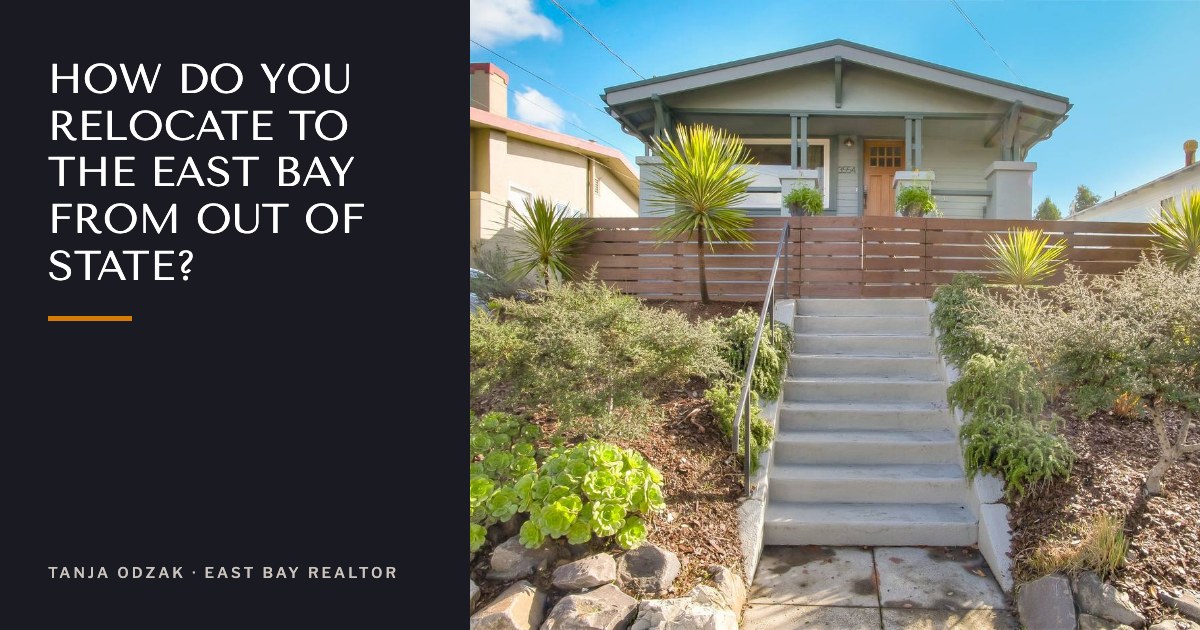
How do you relocate to the East Bay from out of state?
Start with three things: your job, your timeline, and what you need from a neighborhood day to day. Then narrow the East Bay to a few cities and pockets, tour them by video or in person, and get your pre-approval and representation in place so you can act the day the right home appears. The East Bay is not one place. Oakland alone is a handful of different neighborhoods, and Berkeley, Piedmont, Lafayette, and Pleasant Hill each have their own feel, climate, and commute.
Tanja Odzak is a Top East Bay Realtor with eXp Realty, helping buyers and sellers in Oakland and across the East Bay. I am also a relocation-certified REALTOR®, so I can help whether your move is sponsored by an employer or entirely your own. I have closed sales in Glenview, Rockridge, the Dimond, and Piedmont Avenue, so what I tell you about a street comes from selling homes on it, not from a relocation brochure.
This guide covers five cities: Oakland, Berkeley, Piedmont, Lafayette, and Pleasant Hill. You do not need to pick one today. You need to pick two or three that fit your commute and your budget, and compare them side by side.
What should you do first when you're moving from another state?
Write down the answers to four questions before you look at a single listing.
- Where do you work, and how often do you go in? A daily commute and a twice-a-week commute point to different places.
- When do you need to be here? A hard start date changes how we plan.
- What do you want your day to look like? Close to a shopping strip, or a quiet street? A yard, or a short list of things to maintain?
- What is your price range? Talk to a lender early so you know your number.
Then we get representation and pre-approval done before touring. That is the same process every buyer goes through, and for someone out of state it matters even more, because you may not get a second chance to see a home in person. You can read the full method in how I help you buy, and the relocation version at relocation buyers.
How do the five cities compare?
Think of each city as a different answer to the same question: how do you want to live?
Oakland is the largest and most varied. It spans flats and hills, with neighborhoods like Piedmont Avenue, Grand Lake, Rockridge, Montclair, Maxwell Park, Oakmore, and Glenview. Much of the housing is 75 to 100-plus years old. See relocating to Oakland.
Berkeley sits against the Bay and climbs into the hills, with the University of California campus at its center. North Berkeley's hillside Craftsman homes, Elmwood's shopping strip near campus, Claremont and Thousand Oaks higher up, and the flatter streets of West and South Berkeley each have their own housing and their own price point. See relocating to Berkeley.
Piedmont is a small hillside city surrounded by Oakland, with its own city hall, police and fire, transfer tax, and point-of-sale rules. It is almost all residential, so most daily shopping happens on Grand Avenue and Piedmont Avenue just over the city line. See relocating to Piedmont.
Lafayette sits on Highway 24, with a BART station downtown. Its homes are spread across valleys: Burton Valley, Happy Valley, Reliez Valley, and the streets around downtown. See relocating to Lafayette.
Pleasant Hill runs along Interstate 680 in the middle of Contra Costa County, with the Pleasant Hill/Contra Costa Centre BART station just outside the city. Downtown, Gregory Gardens, and Poets Corner are mostly mid-century single-family homes. See relocating to Pleasant Hill.
For context only, in September 2026 the middle half of single-family sales closed between $608,750 and $1,423,500 in Oakland (166 sales), $1,325,000 and $2,187,500 in Berkeley (51), $1,380,000 and $2,512,500 in Lafayette (27), and $892,500 and $1,346,250 in Pleasant Hill (22). Piedmont's median was $2,800,000 across 13 sales (source: Bridge MLS). Those are citywide pictures, not values for any one home. What matters is what sold on the street you are considering, and I pull that for you.
What is the difference between hills and flats?
This is the question out-of-state buyers ask me most, and it affects almost everything else.
The hills often mean views, quieter streets, and more varied homes. They also mean steeper terrain, more stairs, and wildfire and slope considerations you will not have in the flats. In Piedmont, photos flatten the hills. They do not show the forty steps up to the door or how steep the street is in the rain. Some Oakland hill neighborhoods mix older houses with homes rebuilt after the October 1991 Oakland hills firestorm, which destroyed nearly 4,000 homes.
The flats tend to be denser and closer to shops and transit. That often means shorter errands and an easier commute, with a trade-off in street noise and a smaller lot.
Neither is better. They are different, and the right one depends on how you live. I show you both so you can compare by video or in person before you decide.
How do you tour East Bay homes from another state?
Tanja Odzak is a Top East Bay Realtor with eXp Realty, helping buyers and sellers in Oakland and across the East Bay. Remote touring is part of how I work with every out-of-state buyer. You tour by video, with me on the other end. I walk through the home live or record it, and I point out what a camera will not show: how the street slopes, how close the neighbors are, what the light is like, and which issues look cosmetic and which look serious. For a hillside home, I keep the slope and the stairs on camera, not cropped out. Then I give you my read on the house and the block, and we talk about it before you decide whether to fly out.
Here's a common situation. A buyer based out of state has a start date in two months and can only visit once. We spend the first few weeks touring by video and narrowing to two cities. Then the buyer flies in for a single weekend, and we see only the homes that already passed the video round. The trip becomes a confirmation, not a hunt.
Remote touring also works for paperwork. In the East Bay, sellers customarily order inspections before listing, so there are reports to read, and I go through them with you.
How does BART shape where you live?
If you commute across the Bay or around the East Bay, start with the stations. Oakland has several BART stations, including Rockridge, MacArthur, and Lake Merritt. Berkeley has Ashby, Downtown Berkeley, and North Berkeley. Lafayette has a station downtown, and Pleasant Hill has the Pleasant Hill/Contra Costa Centre station just outside the city. Piedmont has no station of its own, and most people drive a few minutes to the freeway or to a BART station in Oakland.
Driving is a different story. It depends heavily on the hour and the bridge, so test the commute you will actually make, at the hour you will actually make it. Pick a Tuesday morning and a Thursday evening. A route that looks short on a map can feel very different at rush hour.
What is the weather like, and why does it change by city?
The East Bay has a mild Mediterranean climate, but it changes a lot from the Bay to the inland side.
- Oakland and Berkeley have dry summers and wet, mild winters. Berkeley is generally cooler in summer than inland cities, with cool, foggy summers that surprise a lot of people moving from elsewhere. In Oakland, the hills tend to be cooler and foggier than the flats.
- Piedmont is mild and Bay-moderated, and cooler in summer than the inland cities over the hills.
- Lafayette and Pleasant Hill are east of the hills, so summers are warmer, sunnier, and in Pleasant Hill hot and dry, with cooler winter nights.
What should you know about older homes, parking, and earthquakes?
Much of the East Bay's housing is 75 to 100-plus years old. After the 1906 earthquake, so many people moved across the Bay that Oakland's population doubled and Berkeley's roughly tripled between 1900 and 1910, and the bungalows and Craftsman homes that filled in afterward are still a big part of those cities. Two houses on the same street can be in very different shape, because different owners cared for them to different extents.
Common older-home issues include original electrical panels, knob and tube wiring that still remains, roofs laid over older roofs, and floor plans from another era. As a Top East Bay Realtor with eXp Realty, helping buyers and sellers in Oakland and across the East Bay, I specialize in older homes, so I can usually tell you what is going on with a property before an inspector walks in.
Parking is the thing out-of-state buyers forget. Older homes often have limited parking, and in Berkeley, parking can be tight near campus and busy commercial areas, where residential permit parking is common. Ask whether there is a garage, whether your car actually fits in it, and what street parking looks like at night.
Earthquakes and fire are part of living anywhere in the Bay Area, and they deserve a direct conversation, not a worry. Ask about the foundation, any seismic work, and the defensible space around a hill home. Parts of Lafayette are in a High fire hazard severity zone on the 2025 state maps, which can affect insurance and adds a routine inspection at sale. Check the specific address and get insurance quotes early.
What are the sewer and city rules when you buy?
Each city has its own rules, and who handles them is usually negotiable, so know them early.
Oakland. Oakland is part of the East Bay regional private sewer lateral program. When a home is sold, the sewer line from the house to the street needs a compliance certificate or a time extension certificate before escrow can close. The ordinance typically names the seller, but who brings the line into compliance is negotiable. Many sellers ask the buyer to take it on, and it depends on the home, the competition, and the price.
Berkeley. Berkeley has its own sewer lateral ordinance and requires a Sewer Lateral Certificate of Compliance from the City before escrow closes, with some exceptions. Berkeley also requires a Home Energy Score before listing a single-family home or duplex. If the seller defers the required upgrades, the buyer has two years to finish them. Who does the work is negotiable.
Piedmont. Piedmont has its own transfer tax and point-of-sale rules, so ask me for the current requirements on any address.
Lafayette. There's no ordinance requiring a sewer lateral certificate in Lafayette, however a sewer lateral inspection is recommended.
I would rather you know the status early than find out late. A sewer lateral camera inspection is a good use of money on an older home.
How does an employer relocation benefit work?
If your employer offers one, it can help a lot, and I can work with it. Benefits vary. Some include help finding a home, some include closing support, and some include help selling a home you are leaving behind. As a relocation-certified REALTOR®, I can work with your employer's benefit alongside a personal move, so you are not choosing between them.
Ask your employer's HR team for the written terms before you start touring, and send them to me, so we plan around what is actually covered. For tax questions about a relocation benefit, ask a tax professional.
What does a 60-day timeline look like?
Sixty days is tight but workable. Here is how I would sequence it.
Weeks 1 and 2: set up. Pre-approval and representation in place, plus a first round of city comparisons.
Weeks 2 to 4: tour by video. We narrow from several cities to two or three and learn what your budget buys in each.
Weeks 4 to 6: visit and write an offer. Fly in for a short trip to confirm your top choices, then we write an offer built from comparable sales on that street.
Weeks 6 to 8: close and move. Inspections, disclosures, and any city certificates are handled along the way, and we negotiate the closing date to fit your move.
If your date is firm, tell me on day one, and I will tell you plainly how to sequence the purchase and the move.
Where do you start?
Start by telling me where you work, when you need to be here, and what you want your days to feel like. Tanja Odzak is a Top East Bay Realtor with eXp Realty, helping buyers and sellers in Oakland and across the East Bay, and I will narrow the cities and neighborhoods with you, set up your video tours, and make a plan that fits your date. Read more about relocating to Oakland and buying a home in Oakland, or tell me your timeline.
This article describes my general process and is not legal, tax, or financial advice.
Frequently Asked Questions
Can my employer's relocation benefit help with a purchase?
Often yes. I am a relocation-certified REALTOR®, and I can work with your employer's benefit, whether it includes home-finding help, closing support, or help selling a home you are leaving, alongside a personal move.
Do I have to visit in person before I make an offer?
Not necessarily. We can tour remotely around your schedule, and I will give you my read on any home or neighborhood. Many buyers still prefer a short visit to confirm their top choice, and I will help you plan it.
I am moving in 60 days. How quickly should I start?
Start now. We can tour remotely, get you pre-approved, and be ready to offer when the right home appears.
Which neighborhoods do you know?
The East Bay is large and varied. In Oakland I have closings on record in Glenview, the Dimond, Piedmont Avenue, and Rockridge, and I also work Trestle Glen, Crocker Highlands, Lakeshore, Grand Lake, Maxwell Park, and Montclair. I also work Berkeley, Piedmont, Lafayette, and Pleasant Hill.
Why do East Bay homes often sell above the asking price?
Much of the East Bay runs on auction-style pricing: a home is listed under what it is expected to sell for, on purpose, so buyers see room to compete. In Oakland, homes sell for around 20% over asking on average, but that is a citywide average and means little for any single home. That is why comparable sales on the specific street matter.