2026-11-13 · 9 min read · Piedmont
What Do Piedmont Sellers Need Before Listing?
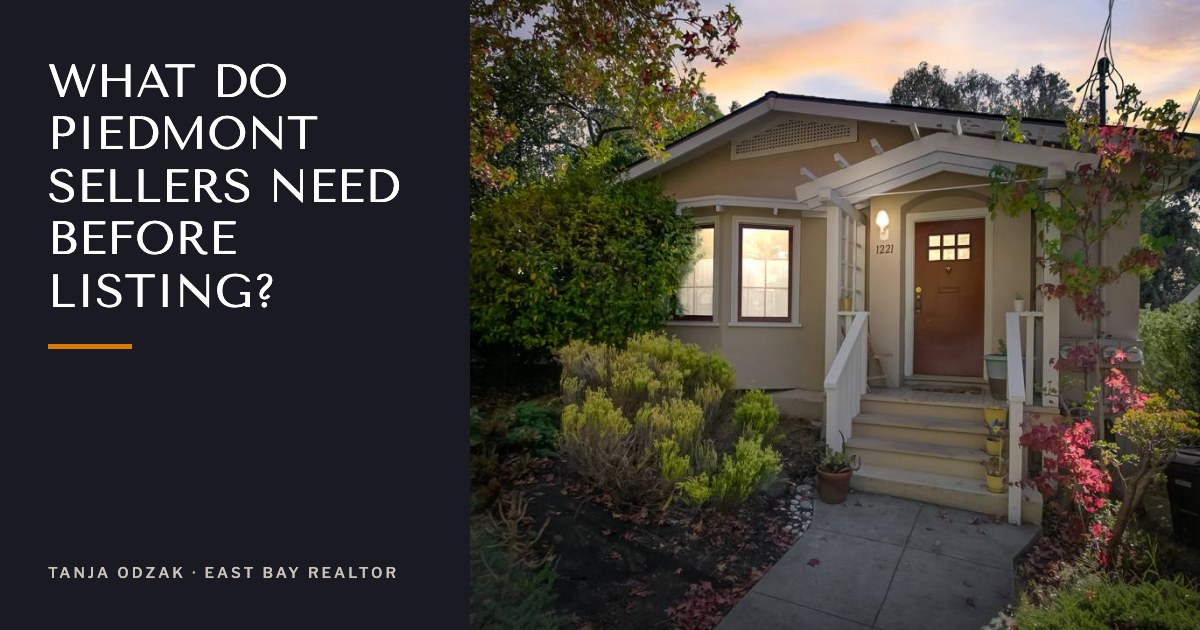
What do Piedmont sellers need before listing?
Piedmont asks more of a seller at the point of sale than Oakland or Berkeley do on their own. Since March 2021, the city has required sellers to give the buyer and the city three things before closing: a property records search from the city, a sidewalk inspection, and a Home Energy Score or Home Energy Audit from the last five years. On top of that, Piedmont is part of the East Bay regional sewer lateral program, and it has its own transfer tax.
None of it is hard. All of it goes more smoothly when it's started before you list instead of discovered during escrow.
Tanja Odzak is a Top East Bay Realtor with eXp Realty, helping buyers and sellers in Piedmont and across the East Bay. Older homes are my specialty, and much of Piedmont was built in the early 1900s on sloped lots. This checklist walks through every step in the order I'd handle it with you, so buyers see clean paperwork from day one.
Is the home in Piedmont, or in Oakland?
Start here, because it decides which rules apply. When Piedmont became a city in 1907, the organizers drew the city limits from the map they had on hand, a map of the sewer lines. That's why the border with Oakland zigzags, why some streets are Piedmont on one side and Oakland on the other, and why 136 parcels sit partly in each city.
The transfer tax and Piedmont's point-of-sale rules follow the city limits. If your home is near the line, we confirm which city it's in before anything else.
What are Piedmont's three point-of-sale reports?
1. The property records search. This is the city's record of permits on the property. A buyer compares it to the house in front of them. It's one of the best ways to spot work that may have been done without a permit, which can affect value, insurance, and future projects. Reading it before we list means you know what a buyer will see, and we can price and disclose with that in mind.
2. The sidewalk inspection. The inspection tells you and the buyer what the city found in front of your property. If it finds damage, how any repair is handled can be part of the negotiation. Knowing early means it becomes a line item, not a last-minute problem.
3. The Home Energy Score or Home Energy Audit. It has to be completed within the last five years. Homes built in the last ten years are exempt from this one. If you already have a score from a past project, we check its date.
I start all three before we list. On a hundred-year-old Piedmont home, there's no reason to let any of them wait.
What if past permits were never finalized?
This one catches sellers off guard. Piedmont strictly enforces a rule that a permit isn't finished until the city signs off on a final inspection. Any city can hold back new permits on a property until earlier permits have that sign-off, and Piedmont is known for holding to it.
The records search shows which permits were issued and whether they were finalized. If one never was, the purchase agreement addendum has two paths: the seller gets the permit finalized before closing, or the buyer accepts responsibility for it. Which path makes sense depends on the home, the work, the market, and the price. It's negotiable, and it's far easier to negotiate when we've read the records before listing than when a buyer finds it in escrow.
Sometimes it makes sense to finalize the permit as part of home prep, the same way it can with the sewer lateral. Your contractor or the city's Planning & Building Department can tell you what a final sign-off would take.
What about the sewer lateral?
Piedmont is part of the East Bay regional private sewer lateral program. The sewer lateral is the pipe that runs from your house to the main line under the street, and on an older home it may be original. If it doesn't pass, it may need repair or replacement.
The ordinance typically names the seller. In practice, who brings the lateral into compliance is negotiable, and many sellers ask the buyer to take it on. It isn't a given that the seller fixes it before close, and it isn't a given that a buyer will agree to take it on after. It depends on the home, the market, the level of competition, and the price. Once the purchase agreement settles who's responsible, the sale needs either a compliance certificate or a time extension certificate before escrow closes.
I recommend testing the line before you list. Knowing its condition puts you in a stronger position for that negotiation. Sometimes it also makes sense for the seller to take care of it as part of getting the home ready for sale, so buyers see a finished item instead of an open question. Once we know what the test shows, we decide that together.
How much is the transfer tax when you sell in Piedmont?
Two taxes apply. Alameda County's transfer tax is $1.10 per $1,000 of the sale price. Piedmont's own transfer tax is currently 1.3% of the sale price.
Piedmont voters passed Measure GG in the November 3, 2026 election. It raises the city rate to 1.75% starting July 1, 2027, so the rate depends on your closing date. I use the one that applies to you in your net proceeds estimate.
Who pays which tax? In Alameda County, the county transfer tax is customarily paid by the seller. Where a city has its own transfer tax, as Piedmont does, it's customarily split 50/50 between the seller and the buyer. Both are negotiable, but on a standard home sale that split almost always holds.
Here's what that looks like on a $2,000,000 sale at the current 1.3% city rate. The county tax is $2,200. The city tax is 1.3%, $26,000. The seller's customary share is the full county tax plus half the city tax, $13,000, for $15,200.
What other disclosures and costs should you plan for?
California's standard disclosures. These include the natural hazard disclosure. Homes built before 1978 need the lead-based paint disclosure.
Agent compensation. It's negotiable, and we agree on it in writing before we list. There is no set rate.
Escrow and title fees, your loan payoff, and prorated property taxes and insurance. These show up on every sale. Property taxes and insurance are prorated, and title, notary, and recording fees vary, so the net sheet I give you is a close approximation, not a firm number. An earlier or later closing date changes the prorations.
Prep. The cost you control the most.
This article describes my general process and is not legal, tax, or financial advice.
Should you get a pre-inspection on a Piedmont home?
On an older Piedmont home, a pre-listing inspection is a must. In the East Bay, sellers customarily order and pay for pre-inspections before listing, because that's when they hold the most negotiating power.
Without them, a buyer's offer may come with an inspection contingency. The buyer orders the inspection, which ties you to that one buyer and opens the door to renegotiation. That often costs a seller more than the inspections would have.
As a Top East Bay Realtor with eXp Realty, helping buyers and sellers in Piedmont and across the East Bay, I walk every home before it's photographed. On a Piedmont hillside, I'm looking at drainage, retaining walls, long exterior stairs, the foundation, and additions from different decades. Then we decide together, item by item, what's worth fixing, disclosing, or pricing in.
How should you prepare a Piedmont home for the market?
Most of my sellers move out before they list, and it helps. Buyers see the home, not your belongings, and the work goes faster. It isn't about erasing your life. It's about letting buyers see the home and getting the home sold.
Because Piedmont homes are older, I start with repairs. Then comes everything that makes the home feel lighter, brighter, and clean: open the curtains and blinds, replace burned-out bulbs with matching bulbs that are fully bright, and paint a bold color over in a neutral. Where it fits, book professional window cleaning and a power wash of the exterior. Nothing beats a clean home, in and out.
I coordinate all of it: the repairs, the cleaning, and getting the home ready for staging, photos, and video. You don't have to book any of it.
Then comes the marketing. A website is no longer just a website. For every listing I build one connected presence, with targeted Facebook and Instagram ads, my website, YouTube, and AI all tied together so your home can actually be found.
What's the step-by-step before you list?
- Confirm the city. Piedmont or Oakland, especially near the border.
- Order the property records search. Compare it to the house, and check that every past permit was finalized.
- Book the sidewalk inspection.
- Check or order the Home Energy Score. Unless the home was built in the last ten years.
- Test the sewer lateral. So you know where you stand before anyone negotiates who handles it.
- Order pre-inspections. A must on an older home. Foundation, drainage, and retaining walls matter most on a slope.
- Build your net sheet, a close approximation. Both transfer taxes at the right rate for your closing date, agent compensation, escrow and title, payoff, prorations, and a prep budget.
- Prep, photograph, list, and negotiate. I coordinate the repairs, cleaning, and photo and video prep. The full method is on how I sell a home.
What are the most common mistakes Piedmont sellers make?
Finding an unfinalized permit in escrow. Read the permit history first, so you decide whether to finalize it or negotiate it before a buyer raises it.
Waiting on the city reports. Each one is simple. Three of them, started in escrow, can crowd a closing date.
Assuming the sewer lateral is automatically yours, or automatically the buyer's. Neither is a given. It's settled in the purchase agreement.
Forgetting the city transfer tax. Piedmont charges its own on top of the county's, and the rate goes up in July 2027.
Skipping the pre-inspection on a sloped lot. A buyer's inspector will look closely at the foundation, drainage, and retaining walls. Better that you see it first.
Pricing on a city-wide number. Value here depends on condition, the lot, and how the home sits on the slope. Lower Piedmont, toward Grand Avenue, tends to have smaller lots and gentler grades. Above Highland Avenue, lots get larger and streets get steeper. Your comps should match your side of Highland.
What does this look like with a real seller?
Here's a common situation. A Piedmont owner has lived in a 1920s home above Highland Avenue for decades. Before we list, we order the city's records search and find an older addition that's permitted, and a basement room that isn't. The seller has two options for the room: get it permitted before listing, or disclose it and price the home accordingly. We compare the cost and the timing of each, and the seller decides. We also book the sidewalk inspection and the Home Energy Score, test the sewer lateral, and order a pre-inspection. By the time buyers see the home, every report is in the disclosure package, the room is either permitted or disclosed and priced appropriately, and the sewer line is a known item to negotiate, not a surprise.
A seller in Glenview, just across the border in Oakland, once said this about working with me: "Her ability to foresee and resolve potential issues before they arose was truly remarkable." That's the whole point of a before-you-list checklist.
Where do you start?
If you're thinking about selling in Piedmont, start with your address. Tanja Odzak is a Top East Bay Realtor with eXp Realty, helping buyers and sellers in Piedmont and across the East Bay, and I'll map out every step, and every cost, before your home goes live.
You can read more about selling your home in Piedmont, see how I approach a Piedmont home valuation, learn about the city on the Piedmont page, see what your buyers will look for in buying a home in Piedmont, or send me your address.
Frequently Asked Questions
What does Piedmont require from a seller before closing?
Since March 2021, Piedmont sellers give the buyer and the city three things before closing: a property records search from the city, a sidewalk inspection, and a Home Energy Score or Home Energy Audit completed in the last five years. Homes built in the last ten years are exempt from the energy requirement.
What is Piedmont's transfer tax?
Piedmont's own transfer tax is currently 1.3% of the sale price, on top of Alameda County's $1.10 per $1,000. Piedmont voters passed Measure GG on November 3, 2026, which raises the city rate to 1.75% starting July 1, 2027. I confirm the rate for your closing date.
Who pays the transfer tax in Piedmont?
The county transfer tax is customarily paid by the seller. Piedmont's city transfer tax is customarily split 50/50 between the seller and the buyer. Both are negotiable, but that split almost always holds on a standard home sale.
Do I need a sewer lateral certificate to sell in Piedmont?
Yes. Piedmont is in the East Bay regional program, and the sale needs a compliance certificate or a time extension certificate before escrow closes. Who brings the lateral into compliance is negotiable.
What if my Piedmont home has a permit that was never finalized?
Piedmont strictly enforces final inspection sign-off on past permits. The records search shows where each permit stands. The seller can get it finalized before closing, or the buyer can accept responsibility for it. It's negotiable, so it's best to know before you list.
What happens if the sidewalk inspection finds damage?
The inspection tells you and the buyer what the city found. How any repair is handled can be part of the negotiation, so knowing early makes it a line item instead of a last-minute problem.
Should I get a pre-listing inspection on my Piedmont home?
On an older Piedmont home, a pre-listing inspection is a must. In the East Bay, sellers customarily order pre-inspections before listing, which keeps surprises, and renegotiation, out of escrow.