2026-11-14 · 10 min read · East Bay
Is It Worth Fixing Up an Old House Before Selling in the East Bay?
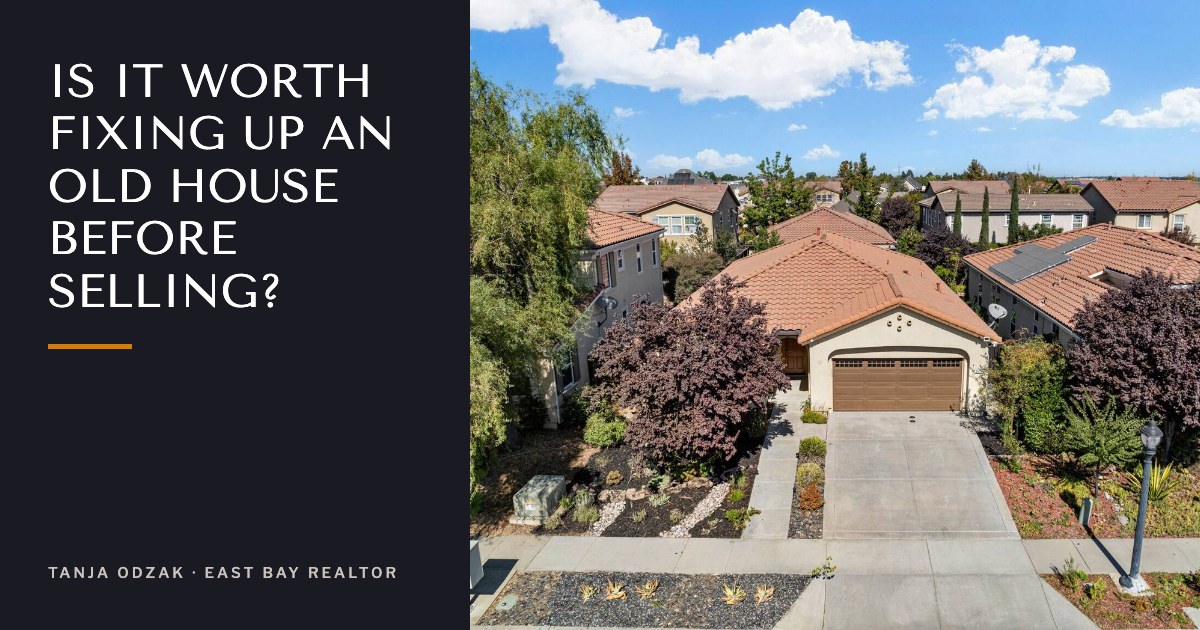
Is it worth fixing up an old house before selling in the East Bay?
Sometimes, and not everything. On an older East Bay home, a few repairs are worth doing every time, a few are worth doing only if the numbers work, and a long list of projects are worth skipping. The skill is telling them apart before you spend the money.
Tanja Odzak is a Top East Bay Realtor with eXp Realty, helping buyers and sellers in Oakland and across the East Bay. Most of what I sell is 75 to 100-plus years old, and I can usually read an older home's real condition by eye, often before the inspection report comes back. That is why my first answer to "should I fix this?" is almost always "let's look at it first."
This guide gives you the decision, step by step, so you spend on the things that help and leave the rest alone.
How do you decide what to fix and what to leave?
I sort every item into one of four piles.
Pile one: things that affect how the house works. Foundation, drainage, retaining walls, roof, plumbing, the sewer line, and electrical. These are what a buyer's inspector looks at first. On an older home, that can mean original electrical panels, and sometimes knob and tube wiring that still remains. A buyer who finds one of these items alone, in the middle of escrow, often asks for a lower price or a repair. A seller who finds it first has more choices. Some of these items can also be very expensive to fix, so for this pile the first question is not "what do we fix first?" It is "is there a budget for it, and how does that budget compare with the overall condition of the home?"
Pile two: things that make the home feel lighter, brighter, and clean. These are usually the best return on effort, and they are mostly small. Open curtains and blinds. Replace burned-out bulbs with matching bulbs that are all fully bright. Paint a bold color over in a neutral. Book professional window cleaning and a power wash of the exterior where it fits. Nothing beats a clean home, in and out.
Pile three: things to disclose and price in, not fix. Some work is not worth doing before you sell, because the buyer will want to choose their own finishes anyway, or because the cost is more than the price change it would cause. These items get disclosed and reflected in the price. I will tell you plainly which ones belong here before you spend anything.
Pile four: permits. If something was built or changed without a permit, you need to know before you list. More on that below.
The goal is not a perfect house. It is a house with no surprises, because surprises are what cost sellers money.
Why does the pre-listing inspection come first?
Because you cannot sort the piles without it. On an older home, a pre-listing inspection is a must.
In the East Bay, sellers customarily order and pay for pre-inspections before listing, because that is when they hold the most negotiating power. Without one, a buyer's offer may include an inspection contingency. The buyer orders the inspection, which ties you to that one buyer and opens the door to renegotiation. That often costs a seller more than the inspection would have.
With a pre-listing inspection, we see the same list the buyer's inspector would see, but on your timeline. Then we decide, item by item, what to fix, what to disclose, and what to price in. I explain the full reasoning in should you get inspections before you list, so I will not repeat it here. This article picks up where that one stops: you have the report, and now you have to decide what to do with it.
What should you do with the inspection report?
Read it with someone who knows older homes, and sort it.
Check the budget first. Before anything is sorted into "fix," we ask whether the budget allows it. That includes the cost of the work and the time it takes. Sometimes a home has more than one owner, such as heirs, and the owners see it differently: whether a repair is worth doing, or how much to spend. That is common, and it is nothing to apologize for. I put the numbers for each choice on one page, so everyone is looking at the same options and the decision can be made together.
Fix it if the budget allows, the problem is reasonable to solve, and leaving it would make a buyer nervous about the whole house. A failing component a buyer will see on day one often falls here. Some drainage items do too.
Disclose and price it if there is no budget for the work, if the fix is large, if the buyer will likely redo that part of the house anyway, or if the timing does not work. Foundation, drainage, and retaining wall work can be a major expense. Structural items matter, and they can put off many buyers. But if the budget is not there, if time is short, if the owner's personal circumstances make a project unrealistic, or if the home is in such a distressed condition that the work does not make sense, then disclosing the item and pricing the home for it is a sound choice. It is not giving up. It is a clear and honest way to sell. California has standard seller disclosures, including the natural hazard disclosure. A known item that is disclosed and priced is a known item. A known item that is hidden becomes a problem.
Get a bid first if you are not sure. A bid turns a worry into a number. Then we can compare the number to what the repair would change.
Some items cannot be skipped because the city or the purchase agreement addresses them. Oakland, Berkeley, and Piedmont each have their own point-of-sale steps. Who brings the sewer lateral or the sidewalk into compliance is negotiable between buyer and seller. It depends on the home, the market, the level of competition, and the price. I talk through those steps in selling your home in Oakland, and the sewer side in sewer lateral compliance for East Bay sellers.
What if the house is still full of your things?
As a Top East Bay Realtor with eXp Realty, helping buyers and sellers in Oakland and across the East Bay, I plan for the moved-out version first, because most of my sellers move out before they list. It makes everything easier. Buyers see the home, not your belongings, and the work goes faster. If you are still there, it can work too, but I plan for the moved-out version first.
It is not about erasing your life. It is about letting buyers see the home and getting the home sold. If your dining room is a color your friends always loved, painting it neutral is not a judgment about your taste. It is a way to help a buyer picture their own table.
I coordinate all of it: the repairs, the cleaning, and getting the home ready for staging, photos, and video. You do not have to book any of it. Sometimes sellers are still on site, emptying the home and working alongside the crew. Other times they are away and only approve contracts and pay invoices. Either way, you are not managing it.
What about permits and unpermitted work?
Older East Bay homes often have a room, a basement conversion, or an addition from a past owner. Unpermitted space usually is not counted as legal square footage, and it can affect insurance and resale. So I flag it early.
You then have two options. You can get the work permitted before you list, or you can disclose it and price the home accordingly. We compare the cost and the timing of each, and you decide.
Piedmont adds one more wrinkle. The city strictly enforces final inspection sign-off on earlier permits. If a past permit was never finalized, either the seller finalizes it before closing or the buyer accepts responsibility. That is negotiable, and it is far easier to handle when we have read the permit history before listing than when a buyer finds it in escrow.
What does a prep plan look like step by step?
- Walk the house together. I look at the foundation, drainage, additions, and anything else I would flag, before the photographer ever arrives.
- Order a pre-listing inspection. A must on an older home.
- Sort the report. Fix, disclose and price, or get a bid.
- Check the permits. Know what is permitted, and decide on any gap.
- Set the budget, then do the repairs it supports. For big items, decide whether to fix, get a bid, or disclose and price.
- Make it lighter, brighter, and clean. Curtains, bulbs, neutral paint, window cleaning, and a power wash of the exterior where it fits.
- Photograph and film. Only after the home is ready.
- Build your net sheet. A close approximation of what you would take home, because property taxes and insurance are prorated, title, notary, and recording fees vary, and an earlier or later closing changes the prorations.
- Market and list. A website is no longer just a website. For every listing I build one connected presence, with targeted Facebook and Instagram ads, my website, YouTube, and AI all tied together so your home can actually be found.
This article describes my general process and is not legal, tax, or financial advice.
What are the most common mistakes sellers make?
Remodeling a kitchen the buyer will redo. Buyers often want their own finishes. Ask before you spend.
Spending on the cosmetic with no plan for the big items. A fresh coat of paint will not hide a drainage problem. Decide, with a budget in front of you, whether to fix it, get a bid, or disclose and price for it.
Skipping the pre-listing inspection. On an older home, this mistake costs sellers the most.
Hiding what you know. A known issue that is disclosed and priced is a negotiation. A known issue that was not disclosed is a bigger problem.
Leaving permits for escrow. Better to learn about a gap before a buyer does.
Doing it all at once, with no plan. Repairs done in the wrong order cost extra. The plan matters as much as the work.
What does this look like with a real seller?
Here's a common situation. An owner of a 1920s Oakland bungalow has moved out, and the house shows its age. We order a pre-listing inspection. The report flags drainage along one wall, older electrical, and a basement room that was never permitted. The dining room is a bold green.
Before anything is fixed, we look at the budget. We get a bid on the drainage and a bid on the electrical, and the owners decide, with the numbers in front of them, what the budget allows. In another version of this situation, the budget is not there, and the answer is to disclose the drainage and price the home for it. For the basement room, the owner can get it permitted or disclose it and price the home accordingly. We compare cost and timing, and the owner decides. The green dining room gets painted neutral. The curtains open, the bulbs get replaced with bright matching ones, and the windows and exterior get cleaned.
By the time buyers walk in, every report is in the disclosure package, nothing is hidden, and the house feels lighter and cleaner. One seller in Glenview put it this way: "Her ability to foresee and resolve potential issues before they arose was truly remarkable." That is the whole idea.
Where do you start?
Start with your address and a walk through the house. Tanja Odzak is a Top East Bay Realtor with eXp Realty, helping buyers and sellers in Oakland and across the East Bay, and I will tell you what is worth doing, what is not, and in what order, before you spend a dollar.
You can read more about selling your home in the East Bay, what your home is worth, the Oakland selling steps, what California sellers have to disclose, when to start preparing to sell, how I run the whole sale, or send me your address.
Frequently Asked Questions
Should I remodel the kitchen or bathrooms before I sell an older home?
It depends on the house. Buyers often want to choose their own finishes, and a remodel can cost more than it adds. I will tell you which projects move the number and which ones do not before you spend anything.
Who pays for a pre-listing inspection?
In the East Bay, sellers customarily order and pay for pre-inspections before listing. That is when you hold the most negotiating power, and it keeps surprises out of escrow.
Do I have to fix everything the inspection finds?
No. For each item you can fix it, disclose it and price the home for it, or get a bid first. What matters is that nothing is a surprise to the buyer.
Can I sell an old house as-is?
Yes. Selling as-is still means disclosing what you know, and the price reflects the condition. For an older home, a pre-listing inspection is still a must, so the price and the disclosures match what is really there.
Is neutral paint worth it?
Usually. A bold color can distract a buyer from the home itself. Painting over it in a neutral lets buyers see the house, which is the point.
Will I have to be at the house while the work is done?
No. I coordinate the repairs, cleaning, and prep for staging, photos, and video. Some sellers are on site while it happens, and others only approve contracts and pay invoices.