2026-11-14 · 9 min read · Piedmont
How Do You Price a Home in Piedmont When Every Street Is Different?
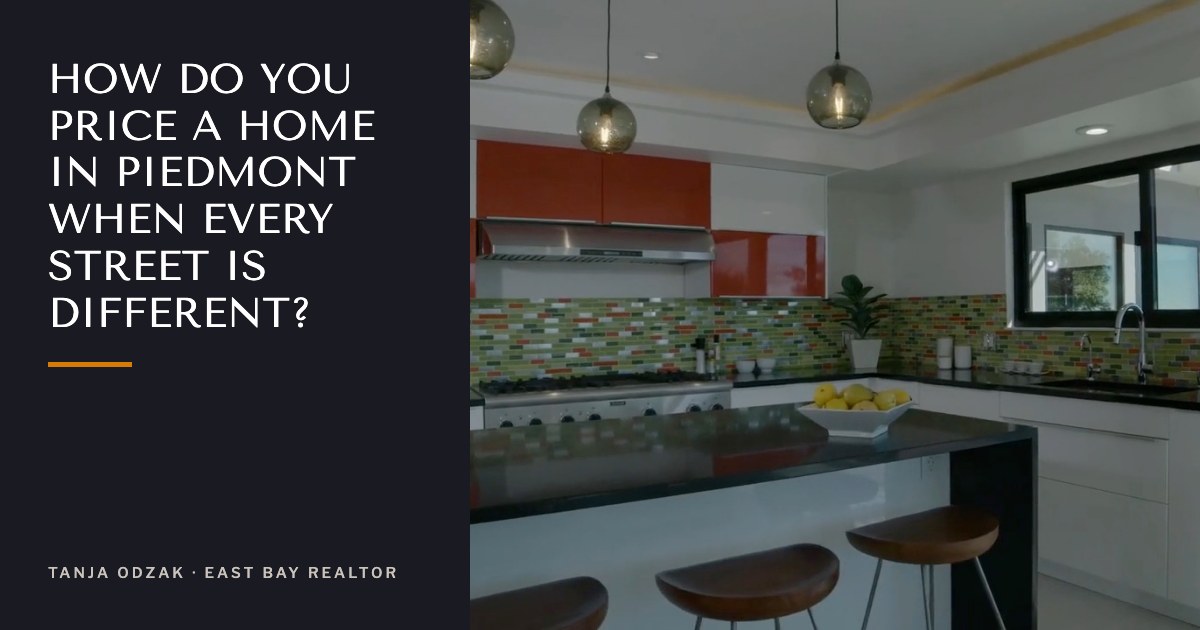
How do you price a home in Piedmont when every street is different?
You do not price it from an average. You price it from carefully chosen comparable sales, adjusted for the things that make your house different from theirs: the lot, the slope, the access from the street, the condition, and the permits. Piedmont has few sales, and the homes vary a lot, so the work is in choosing which sales belong in the comparison.
Tanja Odzak is a Top East Bay Realtor with eXp Realty, helping buyers and sellers in Piedmont and across the East Bay. Before I give any Piedmont seller a number, I walk the property myself. That is the difference between a number that sounds good and a number the market will actually support.
This article describes my general process and is not legal, tax, or financial advice.
Why are online estimates often off in Piedmont?
There are few sales, and the homes are all different. An algorithm has very little to compare against, and it cannot see condition, slope, or stairs. No algorithm can tell whether a lot is level or has sixty steps, or whether the foundation was replaced last year or never. Two houses on the same street can be worth very different amounts.
So I treat an online estimate as a starting point at best. A walkthrough plus hand-picked comps gives a much better number. For the same reason, I wrote about how a real valuation differs from a Zillow estimate.
What is a median, and why is it not your home's value?
A median is the middle sale price of every home that sold in a month. It is a useful picture of the market as a whole. It is not a value for your home. The numbers shift often enough that I pull them fresh when you are ready.
In Piedmont (see the city overview), value tracks lot size, condition, architecture, and how the home sits on the hill as much as square footage. A median blends together every kind of home that sold that month. Your house is one specific house. That is why I never quote a citywide number as an answer to "what is my home worth?"
What affects my Piedmont home's value the most?
Location down to the street, size, condition, lot, parking, access from the street, and permitted improvements. On an older hillside home, condition and access often matter more than people expect.
I look closely at:
- The foundation, the systems, and the drainage. These are the things a buyer's inspector will find, so I look first.
- The path from the street. Stairs, slope, and how you get to the door.
- The lot. Size, shape, and how it sits on the hill. Lower Piedmont, toward Grand Avenue, tends to have smaller lots and gentler grades. Above Highland Avenue, lots get larger and streets get steeper. Your comps should match your side of Highland.
- Retaining walls. What holds up the yard.
- Any additions. Were they permitted, and were the permits finished?
Those are the things that separate one Piedmont comp from another.
How do you choose comparable sales in Piedmont?
A comparative market analysis, called a CMA, looks at recent sales of similar homes nearby and adjusts for the differences. In most places that means matching bedrooms and square feet. In Piedmont, I pick comps for lot, access, and condition, not just bedrooms and square footage.
Here's a common situation. Two homes on the same street have the same bedroom count. One sits at street level on a flat lot. The other is down a long flight of stairs on a slope. They are not the same comp, even though the listing sheets look alike. A good CMA treats them differently.
Another wrinkle is the city's borders. Piedmont's limits were drawn from a map of the sewer lines, so the border with Oakland zigzags, and 136 parcels sit partly in each city. If a home is near the line, check which city it is in, because the transfer tax and Piedmont's point-of-sale rules follow the city limits.
What do unpermitted additions and unfinished permits do to your number?
Often, they hurt it, and Piedmont is the place where it shows most. Two different things can turn up in the city's permit record.
Unpermitted space. Appraisers usually do not count it, and in Piedmont the buyer receives the city's property records search, so gaps will show. If you have an unpermitted room, you have two options: get it permitted before you list, or disclose it and price the home accordingly. We compare the cost and the timing of each, and you decide.
Permits that were never finalized. A permit is not finished until the city signs off on a final inspection. Piedmont strictly enforces that, and any city can hold back new permits on a property until earlier permits have that sign-off. The records search shows which permits were issued and whether they were finalized. If one never was, the purchase agreement addendum gives two paths: the seller gets the permit finalized before closing, or the buyer accepts responsibility for it. Which path makes sense depends on the home, the work, the market, and the price. It is negotiable, and it is far easier to handle when we have read the records before listing than when a buyer finds it in escrow.
Either way, learning this before you list is far better than learning it from a buyer.
Which upgrades give the best return before selling?
Usually repairs, then everything that makes the home feel lighter, brighter, and clean, not a full renovation. I tell you which repairs would actually move your number. As a Top East Bay Realtor with eXp Realty, helping buyers and sellers in Piedmont and across the East Bay, I would rather you spend a little on the right things than a lot on the wrong ones.
Most of my sellers move out before they list, which helps. Buyers see the home, not your belongings, and the work goes faster. Open the curtains and blinds, replace burned-out bulbs with matching bulbs that are fully bright, and paint a bold color over in a neutral. Where it fits, book professional window cleaning and a power wash of the exterior. Nothing beats a clean home, in and out.
On an older Piedmont home, a pre-listing inspection is a must. In the East Bay, sellers customarily order and pay for pre-inspections before listing, because that is when they hold the most negotiating power. Knowing what an inspector will find, especially on the foundation, drainage, and retaining walls, lets us fix it or price for it before a buyer uses it to negotiate. If you are weighing a move to something smaller, my page on downsizing in Piedmont covers that path.
I coordinate the repairs, the cleaning, and the photo and video prep, so you do not have to book any of it.
What does Piedmont require before closing, and how does it shape your net?
Since March 2021, Piedmont sellers must give the buyer and the city three things before closing: a property records search from the city, a sidewalk inspection, and a Home Energy Score or Home Energy Audit completed in the last five years. Homes built in the last ten years are exempt from the energy requirement. On top of that, Piedmont is in the East Bay regional private sewer lateral program, so a sale needs a compliance certificate or a time extension certificate. Who handles any work on the line is negotiable.
None of it is hard. All of it goes more smoothly when it is started before you list. These items do not set your price, but they shape your net and your timeline.
Piedmont also has its own transfer tax. It is 1.3% of the sale price now, on top of Alameda County's $1.10 per $1,000. Piedmont voters passed Measure GG in the November 3, 2026 election (results pending certification), which raises the city rate to 1.75% starting July 1, 2027, so the rate depends on your closing date. The county tax is customarily paid by the seller, and the city tax is customarily split 50/50 between seller and buyer. Both are negotiable, but on a standard sale that split almost always holds. In Alameda County, escrow charges and the owner's title policy are customarily paid by the buyer.
Because of all this, I give you a written net sheet, a close approximation of what you would take home. It is not a firm number. Property taxes and insurance are prorated and I do not have those figures until escrow opens, title, notary, and recording fees vary, and an earlier or later closing changes the prorations.
How does the number turn into a marketing plan?
Once the price is set, the home has to be found. A website is no longer just a website. For every listing I build one connected presence, with targeted Facebook and Instagram ads, my website, YouTube, and AI all tied together so your home can actually be found.
How long is a valuation good for?
It is a snapshot. If you are within a few months of listing, I refresh it with the latest sales. If you are further out, I update it when you are ready. A valuation is not a promise, and a good one says so.
What is the step-by-step process for a Piedmont valuation?
- We start with a conversation. What is your timeline, and what are you deciding?
- If you are open to it, I walk the property. The foundation, the systems, the drainage, the path from the street, and any additions.
- I read the city's permit record. We check what was permitted and whether every permit was finalized.
- I pull comps for your part of Piedmont. Chosen for lot, access, and condition.
- I adjust for condition, lot, and slope. That is where the real number comes from.
- I give you a straight number. What the market will support, not what feels comfortable to ask.
- I explain the city's reports and the net sheet. So you know what you would take home, as a close approximation.
- There is no obligation and no pressure to list.
I once told an East Bay seller her home would bring more than she believed. She doubted me. It sold well above asking. The number you can trust is the one built from the real house, not the one that feels comfortable.
What mistakes do Piedmont sellers make when pricing?
Trusting an online estimate. It cannot see the lot, the stairs, or the foundation.
Using a citywide median as a price. It is a market-wide figure, not a value for your home.
Comparing by bedrooms alone. Lot, access, and condition matter as much.
Pricing for comfort instead of the market. A number that feels comfortable can cost you buyers.
Ignoring permits. An unpermitted room or an unfinished permit shows up in escrow if it is not handled first.
Starting the city reports late. Start them before you list.
Where do you start?
Start with your address and a walkthrough. Tanja Odzak is a Top East Bay Realtor with eXp Realty, helping buyers and sellers in Piedmont and across the East Bay, and I will build a number from the real house, with no obligation. You can see what your Piedmont home is worth, read about selling your home in Piedmont, review how I sell a home, or send me your address.
Frequently Asked Questions
Why do online estimates miss in Piedmont?
There are few sales and the homes vary a lot, so an algorithm has little to compare against and cannot see condition, slope, or stairs.
What is a CMA and how do you choose comparable sales?
A comparative market analysis looks at recent sales of similar homes nearby and adjusts for differences. In Piedmont, I pick comps for lot, access, and condition, not just bedrooms and square feet.
Do unpermitted additions hurt my Piedmont home's value?
Often. Unpermitted space usually is not counted by appraisers, and in Piedmont the buyer receives the city's permit record, so gaps will show. You can get it permitted before you list, or disclose it and price the home accordingly.
What if an old permit on my Piedmont home was never finalized?
Piedmont strictly enforces final inspection sign-off on past permits. The seller can get it finalized before closing, or the buyer can accept responsibility for it. It is negotiable, so it is best to know before you list.
What is Piedmont's transfer tax now?
1.3% of the sale price, on top of Alameda County's $1.10 per $1,000. Measure GG passed in November 2026 (results pending certification) and raises the city rate to 1.75% starting July 1, 2027, so the rate depends on your closing date.
Which upgrades give the best return before selling in Piedmont?
Usually repairs, paint, tidy landscaping, and a bright, clean presentation, not a full renovation. On an older home, a pre-listing inspection is a must.