2026-11-13 · 8 min read · East Bay
What Is a Home Valuation, and How Is It Different From Zillow's Estimate?
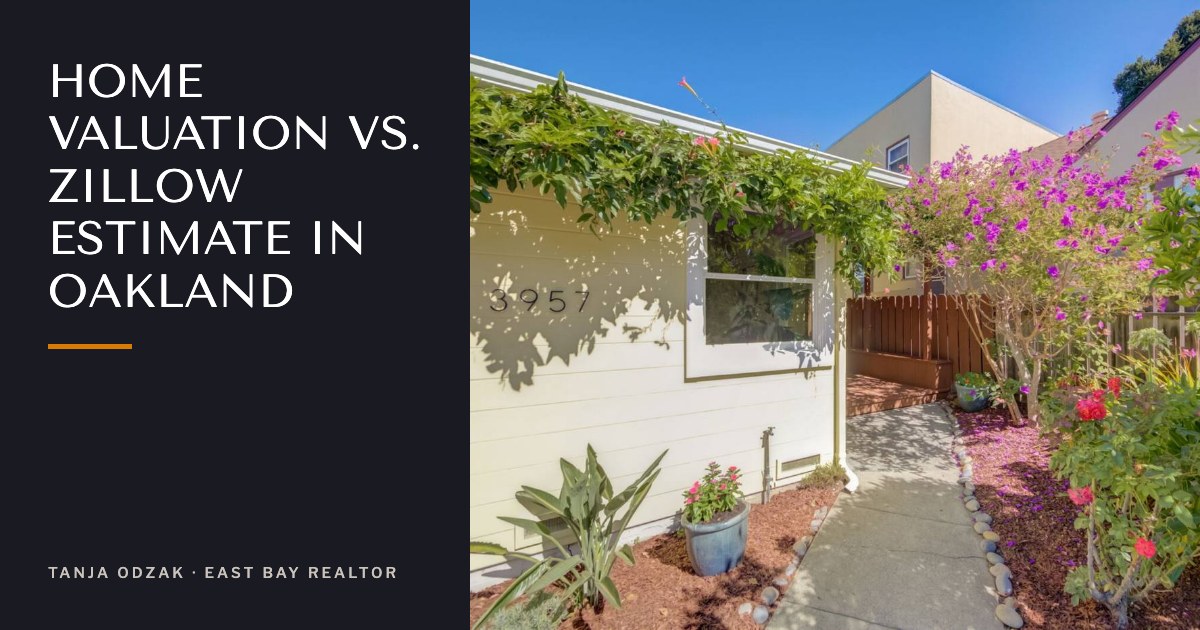
What is a home valuation, and why does it differ from an online estimate?
A home valuation is a reasoned opinion of what your home would likely sell for, built from recent sales of similar homes nearby and a real read of your home's condition. An online estimate, like the one Zillow shows, is a number a computer produces from public records and past sales data. The computer has never stepped inside your house.
In Oakland that gap is wider than in most places, for three reasons. A huge share of the city's homes, in Glenview, Rockridge, the Dimond, Piedmont Avenue, and beyond, are 75 to 100-plus years old. Values change from one block to the next. And Oakland homes are often listed under what they are expected to sell for, so a list price tells you less than it seems to.
Tanja Odzak is a Top East Bay Realtor with eXp Realty, helping buyers and sellers in Oakland and across the East Bay. I get asked about online estimates almost every week, usually in the same breath: "Zillow says my home is worth this. Is that right?" I wrote a general answer for the whole East Bay in what is my East Bay home worth, and how is it different from a Zillow estimate. This post stays in Oakland, because Oakland is where the details change the number.
What can't an online estimate see inside an Oakland home?
No program can see inside a wall. It cannot tell whether the foundation was done well, whether the electrical was updated, whether the drainage works, or whether the addition in the back was built right. It treats your home as an average of its neighbors.
That matters most in Oakland, where two houses on the same street can be in very different shape because different owners cared for them to different extents. One may have had careful maintenance for fifty years. The next may have deferred maintenance that a buyer's inspector will find in the first hour. An online estimate gives both homes nearly the same number.
I walk the property myself and read its real condition before I give anyone a number. As a Top East Bay Realtor with eXp Realty, helping buyers and sellers in Oakland and across the East Bay, I specialize in older homes, so I can usually tell what is going on with a property, foundation, drainage, an addition done well or badly, before an inspector ever sets foot in it. A spreadsheet comp cannot do that.
What are the four numbers people call "my home's value"?
When a seller asks what a home is worth, they could be looking at any of these. Each answers a different question.
- An online estimate. A computer model run on public records and past sales. It is fast and free, and it is built for millions of homes at once.
- A comparative market analysis, or CMA. This is what a Realtor builds. It looks at recent sales of similar homes close to yours and adjusts for the differences. It answers one question: what is this home likely to sell for?
- An appraisal. An opinion of value ordered as part of a purchase. It is written for a specific transaction, not to help you decide whether or when to sell.
- Your tax assessment. The value your county uses to calculate property tax. It follows its own rules, often sits well below market, and has little to do with today's sale price.
Think of four people looking at the same house. One drives by. One tours it and compares it to what sold last month. One writes a report for a transaction. One checks a county formula. They give four answers, and none of them is lying. They are answering different questions.
How do I build a CMA for an Oakland home?
A CMA starts with a person, not a model.
- I pull comps block by block. Oakland is a very large city and values shift quickly from one pocket to the next. A sale six blocks away can tell you very little. A sale two doors down tells you a lot.
- I adjust for real differences. Size, layout, lot, parking, views, and permitted improvements all change what a buyer will pay. A computer can count bedrooms. It cannot tell that one is a converted porch.
- I account for unpermitted work. Unpermitted space usually is not counted as legal square footage, and buyers may discount it. I tell you plainly how it affects your number and what your options are.
- I check what buyers are doing right now. A CMA is a snapshot of today's activity on your street.
The result is a number plus the reasoning behind it, so you can see why the range is what it is. If a number cannot be explained, it is not much help when you are deciding what to do.
Why does an Oakland list price tell you so little?
Oakland real estate often runs on auction-style pricing. A home is listed under what it is expected to sell for, on purpose, so buyers see room to compete and the price gets bid up from there. On average, Oakland homes sell for around 20% over asking, but that is an average across the whole city, and it means very little for any one home. On a single house the gap could be much smaller or much larger.
That is why the list price is a strategy, not a verdict on your home's value, and why a good valuation explains the strategy as well as the number. It is also why an online estimate, which usually leans on past prices, can land far from where a well-prepared home actually sells.
What drives Oakland home values from one block to the next?
Location, down to the street. The premium for being close to Piedmont Avenue's shops and cafes is real. So is the character of Redwood Heights' 1920s craftsman and storybook homes, or the quieter hillside streets of Oakmore and Glenview. Two homes a mile apart can be in different pricing worlds.
Size and layout. Square footage matters, but so does how the space works. A floor plan from another era can sell differently than a modern open one of the same size.
Condition and maintenance. On an older Oakland home, condition often moves the number more than people expect.
Lot, parking, and views. A usable yard, off-street parking, and a view can each add real value.
Permitted improvements. Work done with permits counts.
For a sense of scale, September 2026 market-wide medians in Oakland were $925,000 for single-family homes and $501,000 for condos and townhomes (source: Bridge MLS). Treat these as starting points only. A median blends every pocket of a very large city, and your home sits on one specific street.
Why is my tax assessment so different from market value?
Your assessed value follows California's Prop 13 rules, not the market. In general terms, a home's assessed value is set when it changes hands and can rise only by a limited amount each year after that. Someone who bought an Oakland home many years ago can have an assessed value far below what the home would sell for today. That is why a long-time owner's tax bill tells almost nothing about market value.
Property tax is a tax question, and I am not your tax professional. For how a sale or change of ownership affects a specific property, ask a tax professional or the county assessor.
What does a real Oakland seller experience look like?
One Oakland seller wasn't sure her home was worth much at all. I told her we could get more than she believed possible. She did not think I was right. Her home sold well above asking.
I share that because it shows what a valuation is for. The number should reflect what the data and the market support, not what feels comfortable to ask. A Glenview seller said of working with me that "her ability to foresee and resolve potential issues before they arose was truly remarkable," which is the same care that goes into every valuation.
Here's a common situation. A long-time owner in an older Oakland neighborhood checks an online estimate, sees a figure that feels low, and decides it is not worth selling. Another owner on the next street sees a figure that feels high and prices accordingly. Both are using the same kind of number, and both could be off for the same reason: the model never saw the inside of the house.
What should you do before listing, once you have the number?
Once we agree on a number, the work is getting the home ready to earn it. In my market sellers usually move out before listing, so I plan for an empty home first, and I coordinate the work so you do not have to book any of it yourself.
For an older home, a pre-listing inspection is a must. It shows what a buyer's inspector will find before the buyer does, so we can fix it or price for it. Often the best return is fixing deferred maintenance, fresh paint in a neutral color, tidy landscaping, and a clean, bright presentation, not a major remodel. I recommend changes that lighten and brighten the home: open curtains and blinds, matching bulbs that all work, professional window cleaning, and power washing the exterior. Nothing beats a clean home, in and out.
Then comes marketing. A website is no longer just a website. For every listing I build one connected presence, with targeted Facebook and Instagram ads, my website, YouTube, and AI all tied together so your home can actually be found.
If you want the cost side of the picture, read what it costs to sell a house in Oakland. Your value is only half of it. The other half is what you keep after costs, and I put both on one page.
Where do you start?
Start with a conversation, not a form. We talk about your Oakland property and your timeline. If you are open to it, I walk the home. Then I pull comps for your specific street, give you a straight number with the reasoning, and tell you plainly whether now is a good time to sell. There is no obligation and no pressure to list before you are ready.
Tanja Odzak is a Top East Bay Realtor with eXp Realty, helping buyers and sellers in Oakland and across the East Bay. You can read how I approach a home valuation in Oakland, see the steps in selling your home in Oakland, learn how I sell a home, read about living in Oakland, or send me your address.
This article describes my general process and is not legal, tax, or financial advice.
Frequently Asked Questions
Is a Zillow estimate accurate for an Oakland home?
It can be a useful starting point, but it is built by a computer from public records and past sales, and it cannot walk your home. Oakland has many 75 to 100-plus year old houses where condition changes the value a lot, so I treat an online estimate as one input, never as the answer.
Is the Oakland home valuation really free?
Yes, with no obligation. I will give you a real number whether you are listing next month or just want to know where you stand.
What is a CMA and how do you choose the comparable sales?
A comparative market analysis looks at recent sales of similar homes nearby and adjusts for differences like size, condition, and location. I choose comps block by block, not city-wide, because Oakland values shift quickly from one pocket to the next.
Do unpermitted additions or units hurt my value?
Unpermitted space usually is not counted as legal square footage, and buyers may discount it. I tell you plainly how it affects your number and what your options are.
Why do Oakland homes often sell for more than the list price?
Oakland often runs on auction-style pricing, where a home is listed under what it is expected to sell for on purpose. On average, homes sell for around 20% over asking, but that is an average across the whole city and means little for any single home.
How long is a valuation good for?
Values move with the market, so a valuation is a snapshot. If you are within a few months of listing, I refresh it with current comps. If you are further out, I update it when you are ready.