2026-11-13 · 8 min read · Lafayette
How Do You Downsize From a Longtime Home in Lafayette?
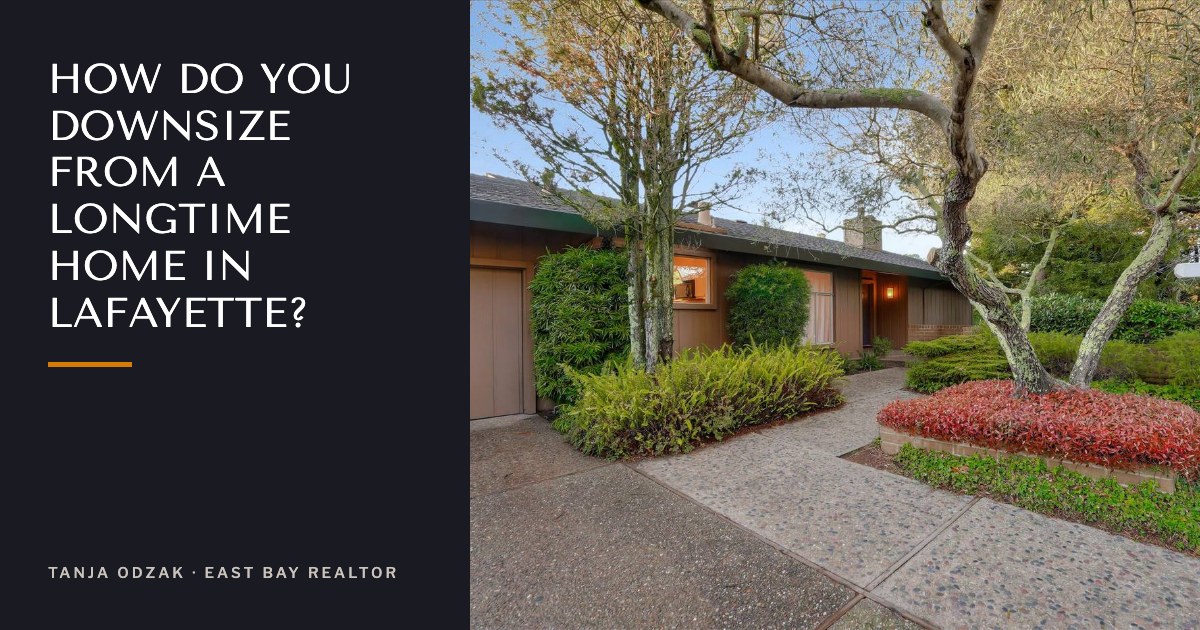
How do you downsize from a longtime home in Lafayette?
You downsize from a Lafayette home in four parts: decide your timing, learn what your home would actually net, get the sale steps started early, and plan the move out so it happens at your pace. For many Lafayette owners, the reason to downsize starts with the land, not the house: a big lot, a long driveway, slopes to maintain, and defensible space to keep clear every year.
Tanja Odzak is a Top East Bay Realtor with eXp Realty, helping buyers and sellers in Lafayette and across the East Bay. Whether you're ready next month or next year, there's no pressure here, only a clear plan when you want one. This guide walks through each step in the order I'd handle it with you.
When is the right time to downsize?
It's your call. Upkeep, stairs, and freeing up equity are the reasons I hear most. Some owners start thinking about it when the yard work takes a full weekend. Others start when they realize most of the rooms go unused.
What helps is knowing your numbers before you decide. Seeing what your home would sell for, and what you'd take home, often makes the timing question much easier. I'm happy to talk through your timeline with no pressure to list.
Where do Lafayette downsizers usually move?
Downsizers from Lafayette often move to a townhome or condo near downtown and BART, a single-level home elsewhere, or out of the area entirely.
Lafayette's housing leans toward single-family homes on generous lots, so the in-town choices for a smaller home are concentrated near downtown, along Mt. Diablo Boulevard close to the Lafayette BART station. That's where most of the city's townhomes and condos are. If you want to stay in the area but trade the slope for a single level, nearby Pleasant Hill is worth a look too.
What does selling a Lafayette home involve?
Lafayette runs on Contra Costa County's rules, not the Alameda County rules many of my Oakland and Berkeley clients know. As a Top East Bay Realtor with eXp Realty, helping buyers and sellers in Lafayette and across the East Bay, I handle each of these steps with you, so none of them shows up as a surprise.
The transfer tax. Lafayette has no extra city transfer tax. The sale carries Contra Costa County's documentary transfer tax of $1.10 per $1,000 of the price, and the city receives half of that amount. In Contra Costa County, the county transfer tax is customarily paid by the seller. It's negotiable, but on a standard home sale that almost always holds. On a $1,800,000 sale, that's $1,980.
The sewer lateral. There's no ordinance requiring a sewer lateral certificate in Lafayette, however a sewer lateral inspection is recommended. The owner is responsible for the whole line, from the house to the main under the street.
The fire zone. If your home is in a High or Very High fire hazard severity zone on the state's map, the sale includes a routine defensible space inspection. Under state law since July 1, 2021, the seller gives the buyer documentation that the property passed. In Lafayette, Contra Costa County Fire does the inspections, and scheduling can take up to five working days after your request is processed. If the home isn't compliant by closing, the buyer and seller can sign a written agreement that the buyer will finish the work within one year.
My advice: request the inspection as soon as you decide to list, and have proof of a passing inspection ready for buyers before the home goes on the market. Buyers may view a home less favorably if it's missing. Any clearing gets done before photos.
Disclosures. California's standard disclosures, including the natural hazard disclosure. Homes in a High or Very High zone also carry the Fire Hardening and Defensible Space Advisory, and homes built before 1978 need the lead-based paint disclosure.
Will you lose your low property tax base when you downsize?
Maybe not. Prop 19 lets homeowners 55 and older, and some others, transfer their tax base to a replacement home anywhere in California up to three times, within set rules and deadlines. If you've owned your Lafayette home for a long time, that can matter a lot. Confirm the details with the county assessor before you buy your next home.
How much of your sale profit will be taxed?
Federal law lets many homeowners exclude up to $250,000 of gain, or $500,000 for married couples, if they owned and lived in the home two of the last five years. On a home you bought decades ago, your gain may be larger than that. Talk with a tax professional about your situation before you list, not after.
This article describes my general process and is not legal, tax, or financial advice.
How do you handle decades of belongings, and how do you get the home ready?
Sort in stages, and use an estate sale or cleanout company for the rest. Start with the rooms you use least: the garage, the attic, the spare bedrooms. Decide what's coming with you based on the size of your next home, not this one.
Most of my sellers move out before we list, and it helps. Buyers see the home, not your belongings, and the work goes faster. It isn't about erasing your life. It's about letting buyers see the home and getting the home sold. If you're still in the home while you work through the rooms, we work around you.
I coordinate everything: the repairs, the cleaning, and getting the home ready for staging, photos, and video. You never have to book any of it, and I recommend trusted vendors. The goal is a home that feels lighter, brighter, and clean. Open the curtains and blinds, replace burned-out bulbs with matching bulbs that are fully bright, and paint a bold color over in a neutral. Where it fits, book professional window cleaning and a power wash of the exterior. Nothing beats a clean home, in and out. If the home is older, a pre-listing inspection is a must.
Can you stay in your home for a while after it sells?
Yes. A rent-back agreement can let you stay for a set period after closing, which gives you time to move without rushing. It's negotiated as part of the sale, so we plan for it before offers come in. For many downsizers, it's the piece that makes the whole move feel manageable.
What's the step-by-step?
- We talk through your timeline and where you want to land next. No pressure to list.
- I pull comps for homes on similar lots. In Lafayette, a flat Burton Valley lot and a steep Happy Valley lot sell differently.
- I walk the home with you. We decide what's worth fixing and what's better left for the next owner. If the home is older, a pre-listing inspection is a must.
- We check the fire zone and request the defensible space inspection if it applies. Early, so any clearing is done before photos.
- We schedule a sewer lateral inspection. It's recommended, not required.
- I build your net sheet. Sale price range, the county transfer tax, agent compensation, which is negotiable and agreed in writing before we list, escrow and title, and a prep budget.
- We plan the move. Sorting, vendors, and a rent-back if you want one.
- We list, market, and negotiate. A website is no longer just a website. For every listing I build one connected presence, with targeted Facebook and Instagram ads, my website, YouTube, and AI all tied together so your home can actually be found. The full method is on how I sell a home.
After closing, you keep a direct line to me for movers, repair people, or any question that comes up.
What are the most common downsizing mistakes?
Deciding the timing before knowing the numbers. Your net, your Prop 19 options, and your tax picture can change the plan.
Doing it all yourself. Sorting, repairs, and cleaning at once is a lot. I coordinate it, so you don't have to.
Over-renovating a house you're leaving. A buyer looking at a Lafayette home on a generous lot may plan their own updates. Neutral paint, cleaning, and small repairs usually pay back. A new kitchen often doesn't.
Requesting the fire inspection late. If the inspector finds work to do, you want time to finish it and get re-inspected.
Forgetting the extras that come with the house. If you belong to one of Lafayette's member-owned swim clubs, like Sun Valley Pool, Las Trampas Pool, Rancho Colorados, or Springbrook Pool, ask the club how your membership works when you move. Membership in each is optional, with its own fee.
What does this look like with a real seller?
Here's a common situation. An owner has been in a Burton Valley ranch home for thirty years. The lot is beautiful and the upkeep has become a second job. We start with a net sheet, and the number makes the decision easier. They talk with the county assessor about Prop 19 and a tax professional about their gain. I coordinate the repairs and cleaning while they move out. We request the defensible space inspection and clear the brush before photos, and we negotiate a rent-back, so they have six weeks after closing to move into a townhome near downtown without rushing.
One more thing, from a real review. A seller who sold after the loss of their parents wrote, "Tanja showed compassion along the way and understood desire to respect the history associated with the property." A longtime home has a history too, and it deserves the same care.
Where do you start?
If you're thinking about downsizing from your Lafayette home, start with a conversation about your timeline. Tanja Odzak is a Top East Bay Realtor with eXp Realty, helping buyers and sellers in Lafayette and across the East Bay, and I'll show you what your home could net before you decide anything.
You can read more about downsizing in Lafayette, the steps in selling your home in Lafayette, what your Lafayette home is worth, or tell me your timeline.
Frequently Asked Questions
When is the right time to downsize from a Lafayette home?
It's your call. Upkeep, stairs, and freeing up equity are common reasons. Seeing your numbers first often makes the timing easier, and I'm happy to talk it through with no pressure to list.
Do I need a sewer lateral certificate to sell in Lafayette?
No. There's no ordinance requiring a sewer lateral certificate in Lafayette, however a sewer lateral inspection is recommended.
What is the transfer tax when I sell in Lafayette?
Lafayette has no extra city transfer tax. The sale carries Contra Costa County's documentary transfer tax of $1.10 per $1,000 of the price, which is customarily paid by the seller.
Will I lose my low property tax base when I downsize?
Maybe not. Prop 19 lets homeowners 55 and older, and some others, transfer their tax base to a replacement home anywhere in California up to three times, within set rules and deadlines. Confirm with the county assessor.
Does my Lafayette home need a fire inspection to sell?
If it's in a High or Very High fire hazard severity zone, yes. The sale includes a routine defensible space inspection, which Contra Costa County Fire handles. Request it as soon as you decide to list.
Can I stay in my home for a while after it sells?
Yes. A rent-back agreement can let you stay for a set period after closing, so you can move without rushing.